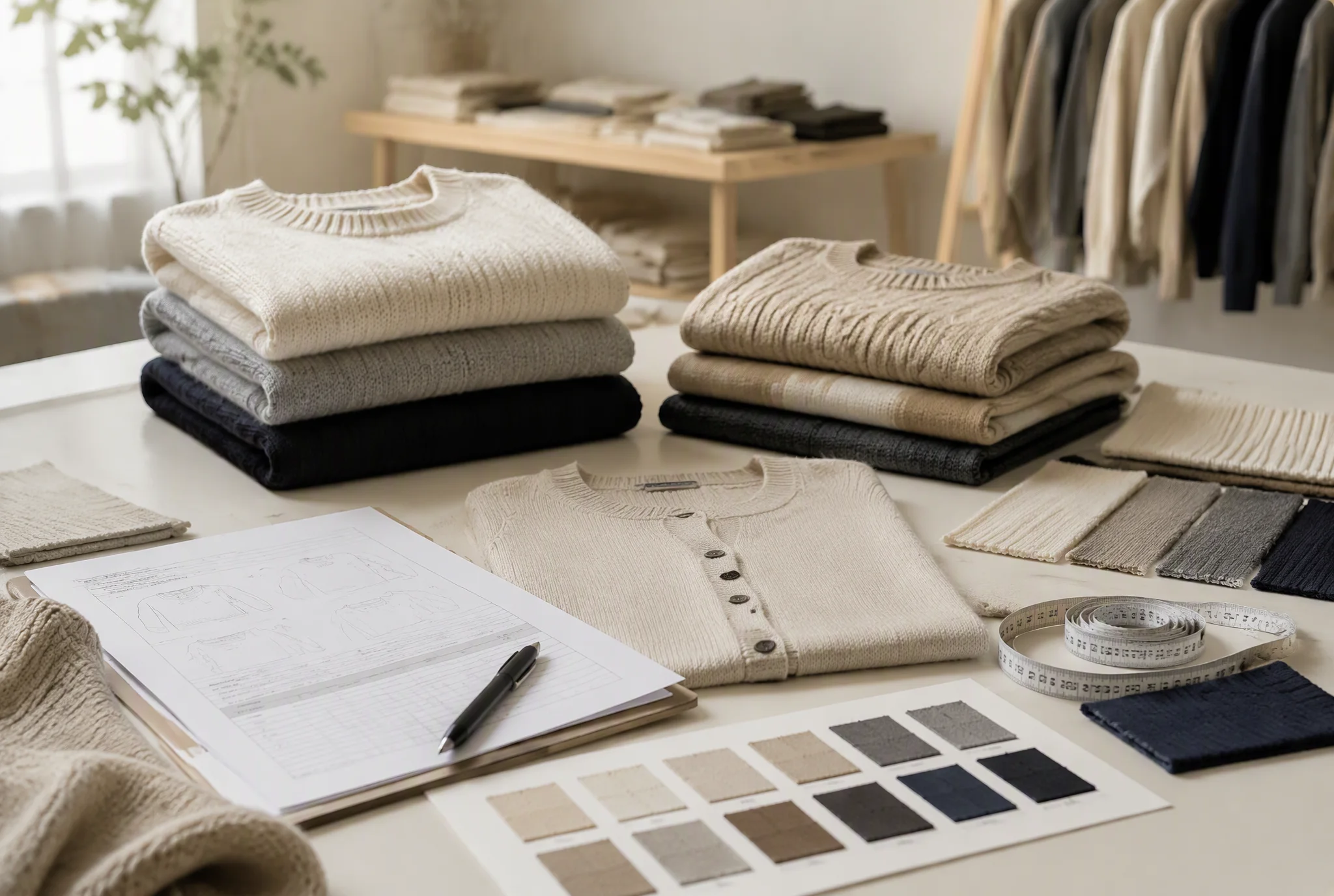
Plan a first bulk knitwear order by defining the product and target customer, choosing a manageable number of colorways, preparing a practical knitwear size breakdown, and confirming the sample before bulk production. For adult knitwear, MOQ starts from 100 pcs per colour. Sampling usually takes 7–15 days, with the fastest projects around 7 days depending on yarn availability, style complexity and workmanship. Bulk timing is confirmed after sample approval and depends on quantity, yarn, complexity, workmanship, packaging and the production schedule.
Use this article before requesting a quote or approving a sample. Separate confirmed requirements from open decisions, send the same information to each supplier, and update the plan when a sample or yarn choice changes. It is a purchasing preparation guide, not a quotation or a guaranteed delivery commitment.
- Define the first bulk order before contacting a supplier
- Evaluate MOQ and quantity per color
- Plan colorways without splitting the order too thin
- Build a practical knitwear size breakdown
- Use sampling and approval as the production checkpoint
- Prepare the information a manufacturer needs
- Turn the plan into a useful inquiry
- Frequently asked questions
1. Define the first bulk order before contacting a supplier
Start by deciding what role the order plays in the collection. A first bulk run may support a seasonal launch, test demand for a new label, introduce a new silhouette or begin a private label program. The purpose affects how many styles and colorways are sensible to develop at the same time.
Describe the product clearly: women’s or men’s knit top, sweater, cardigan, dress or another knitwear category. State the intended customer, market and fit direction. A regular-fit knit top, relaxed sweater and layering cardigan may require different measurements and quantity assumptions. If a tech pack is available, organize it before the inquiry; the knitwear tech pack requirements guide is a useful reference.
Prepare a working quantity plan rather than sending only a total number. List the style, proposed colors, estimated quantity per color, size range and whether the first order may be followed by a reorder. This does not need to be the final purchase order, but it gives a supplier enough context to discuss the right development and production route.
2. Evaluate MOQ and quantity per color
MOQ should be reviewed together with style, color and production method. A total quantity can look adequate while each color is too small for the intended order plan. Ask whether the MOQ is calculated per style, per color or by another structure, and show the estimated allocation rather than asking only “What is your MOQ?”
For CZ Knitwear, the confirmed starting reference for adult knitwear is 100 pcs per colour. Treat this as a starting guideline, not a universal promise for every style, yarn, construction or special finish. The final production assessment is made from the actual design, material availability, color requirements, sample result and production plan.
If the expected quantity is below that starting structure, explain the commercial context: for example, a new brand testing demand or a controlled first launch. A supplier can then assess the proposed route with the style, colorways and possible reorder in view. Keep the quantity plan flexible until the sample and material decisions are confirmed.
3. Plan colorways without splitting the order too thin
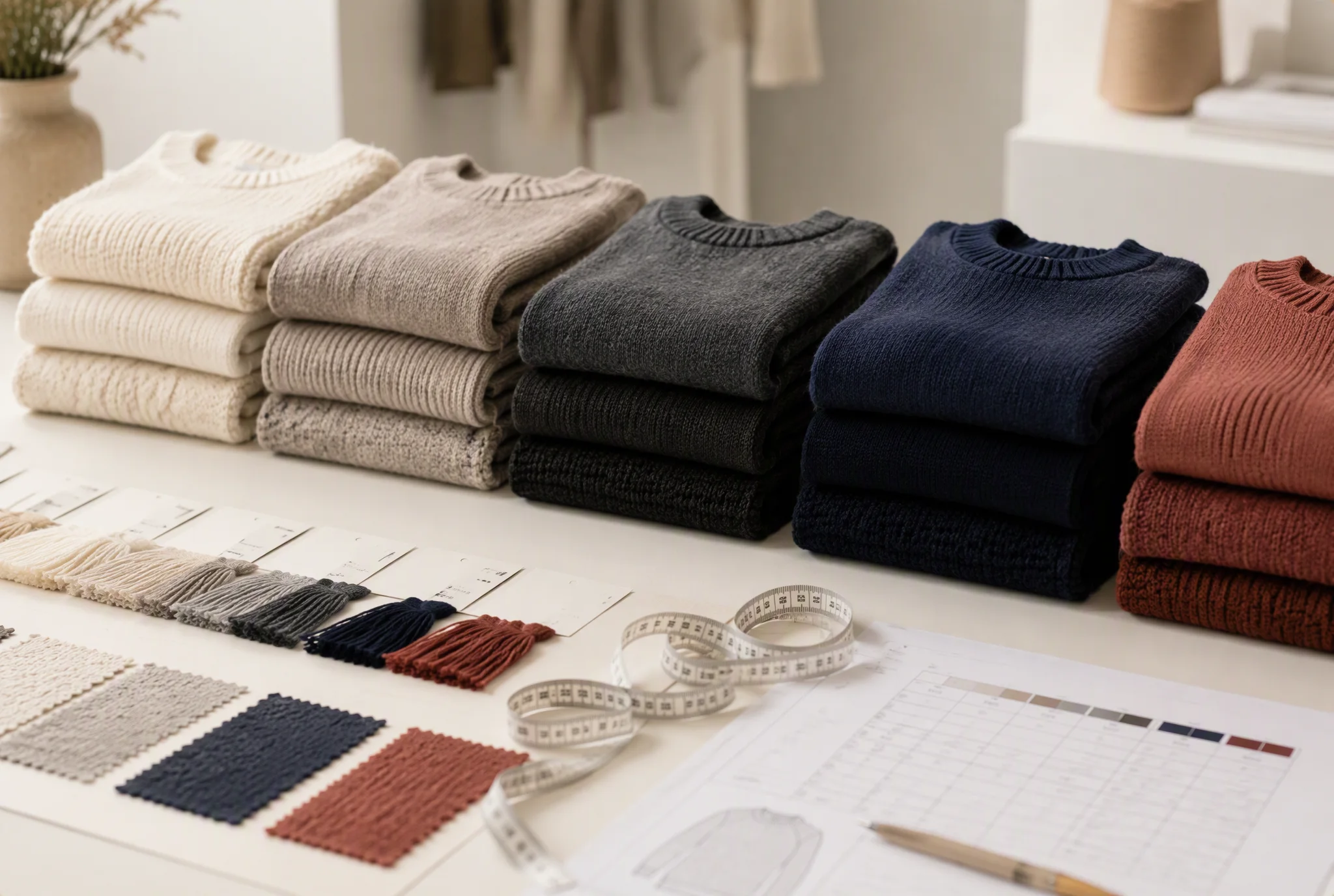
Colorway planning is one of the most important decisions in a first wholesale knitwear order. More colors can broaden a collection, but they also divide the available quantity across more production units. A focused palette often gives a buying team a clearer first test than many colors with very small allocations.
Separate core colors from test colors. Core colors support the main collection and may be prioritized for the largest allocations; test colors explore a seasonal direction or a smaller customer segment. If there is sales or preorder information, use it. If there is no history, explain the collection concept and customer profile instead of presenting one ratio as a universal rule.
For each color, record the color name or reference, priority, planned quantity and whether the shade must be matched closely or may follow an available yarn shade. Ask the manufacturer to confirm what can be developed and sampled before the bulk order is frozen. When one shade changes, update the colorway plan and the quantity-per-color total together.
4. Build a practical knitwear size breakdown
A knitwear size breakdown should reflect the target market, customer profile and product silhouette. There is no single size ratio that suits every country or every style. A fitted knit top, oversized sweater and unisex cardigan can have different demand patterns.
If similar products have sold before, use the brand’s own size information or preorder signals to create a first allocation. For a new brand, document the intended size range and fit direction clearly: regular, relaxed, cropped, oversized or designed for layering. Keep the plan open until the fit sample has been reviewed.
Give the manufacturer the size range, measurement chart and grading information available. A useful working table includes the size label, planned quantity, measurement reference and notes. The notes can identify priority sizes or a fit issue to check. If the chart is still provisional, label it as such rather than presenting it as final.
| Order-planning item | What to record before the quote |
|---|---|
| Style | Product category, silhouette, target customer and intended market. |
| Colorways | Color reference, priority, planned quantity per color and flexible shades. |
| Size breakdown | Size range, quantity by size, measurement chart and fit notes. |
| Sample checkpoint | Sample required, approval status and decisions still open. |
| Order context | First-run purpose, target window and possible reorder. |
5. Use sampling and approval as the production checkpoint
A sample should normally come before bulk production when fit, construction, yarn, color or workmanship details are not fully confirmed. Sampling is not only a visual preview; it creates a shared reference for measurements, construction, appearance and the order plan.
- Brief review: confirm the style, references, measurements, yarn direction, colors and target quantity.
- Material and gauge review: confirm the yarn direction and selected gauge; adult knitwear ranges from 3GG–22GG, with the suitable gauge depending on the design, yarn and required result.
- First sample: develop the garment against the agreed inputs and identify any material or construction decision that remains open.
- Buyer review: check fit, measurements, stitch structure, proportions, color direction, workmanship and finishing.
- Revision approval: record comments and name the exact approved sample revision.
- Bulk handover: connect the approved reference with color, size breakdown, labels, packaging and the order-specific schedule.
Sampling usually takes 7–15 days. The fastest projects can be around 7 days, depending on yarn availability, style complexity and workmanship. The timing should be confirmed for the actual brief. The knitwear sample approval checklist can help a buying team record the review.
For the transition from an approved sample to production, see the knitwear sample-to-bulk order guide. Approval of a sample does not itself confirm a bulk delivery date; the production schedule is confirmed after the order details are reviewed.
6. Prepare the information a manufacturer needs
A supplier needs enough information to assess the development and production route. Include the product type, reference images or tech pack, construction details, yarn and color direction, gauge if known, size range, measurement chart, estimated quantity and number of styles.
State whether a sample is required and which decisions are final or provisional. If a tech pack is not complete, send the information already confirmed and ask what is needed next. This is more useful than sending a single product image with a request for the lowest price.
If the project is private label, list branding and packing requirements that form part of the order, such as labels, hangtags, care information, polybags or cartons. Keep these items in the same order record as the colorway and size plan. For market-specific preparation, buyers can also review knitwear sizing and fit for US and EU markets and US and EU knitwear labeling requirements.
Finally, state the target delivery window without asking for a fixed promise before sample and material confirmation. Bulk timing after sample approval depends on quantity, yarn, style complexity, workmanship, packaging and the production schedule.
7. Turn the plan into a useful inquiry
A clear inquiry explains the order structure in a few lines. Include the category, number of colorways, estimated quantity per color, size range, sample status and intended launch window. If the first run is a demand test and a reorder may follow, say so. This gives the manufacturer a better basis for discussing MOQ and the next step.
We are developing a knitwear style for a private label collection. We are considering [number] colorways and an estimated quantity per color, with a sample required before bulk production. The target market is [market], the fit is [fit direction], and the planned window is [window]. Please confirm the suitable development route, MOQ structure, sample requirements and information needed for a quotation.
Before sending, check that every color has a priority and quantity, every size has a planned allocation or an explicit open decision, and every sample comment is tied to a named revision. A focused first plan can still change, but the assumptions should be visible to both sides.
For buyers comparing cooperation routes, the OEM/ODM knitwear service guide, private label knitwear manufacturer service and low MOQ knitwear manufacturing guide provide related context.
8. Frequently asked questions
What is the MOQ for a first bulk knitwear order?
For adult knitwear, the starting reference is 100 pcs per colour. The final assessment depends on the style, yarn, construction, color requirements and production plan. Include the number of colors and estimated quantity per color when asking about MOQ.
Should I order one color or several colorways first?
That depends on the collection plan, available quantity and expected customer demand. Prioritize core colors and keep test colors limited when the total first-run quantity is small. A supplier can give more useful feedback when priority colors have quantities.
Do I need a sample before placing a bulk order?
A sample is recommended when fit, construction, yarn, color or workmanship details are not fully confirmed. The approved sample and measurement information provide a shared reference before bulk production begins.
What information should I include in a knitwear inquiry?
Include the product style, target market, references or tech pack, yarn and colors, estimated quantities, size range, sample status, branding or packaging requirements and target delivery window. Also explain whether the first order may be followed by a reorder.
How long does sampling take?
Sampling usually takes 7–15 days, with the fastest projects around 7 days depending on yarn availability, style complexity and workmanship. The actual timing is confirmed after the brief and material requirements are reviewed.
Ready to plan your first bulk knitwear order?
Send CZ Knitwear the style reference, colorway plan, knitwear size breakdown, estimated quantity per color and sample status. The team can review the information needed for the next step in your wholesale knitwear or private label project. Review the private label knitwear service before making an inquiry.