Why Knitwear MOQs Start at 100 Pieces Per Color: Yarn, Gauge, Color & Machine Setup Explained
Finding a low MOQ knitwear manufacturer is one of the first challenges many emerging fashion brands face. But in custom knitwear, MOQ is not simply about the total number of sweaters in one style. Yarn preparation, gauge, color planning, machine setup and sampling all affect the quantity required for stable bulk production.
At CZ Knitwear, custom bulk production normally starts from 100 pieces per color. The MOQ is calculated by color, not simply by the combined quantity of one style. For example, if one sweater is produced in four colors, the normal minimum would be 100 pieces × 4 colors = 400 pieces total. Dividing 100 pieces into four colors of 25 pieces each does not meet the bulk production MOQ.
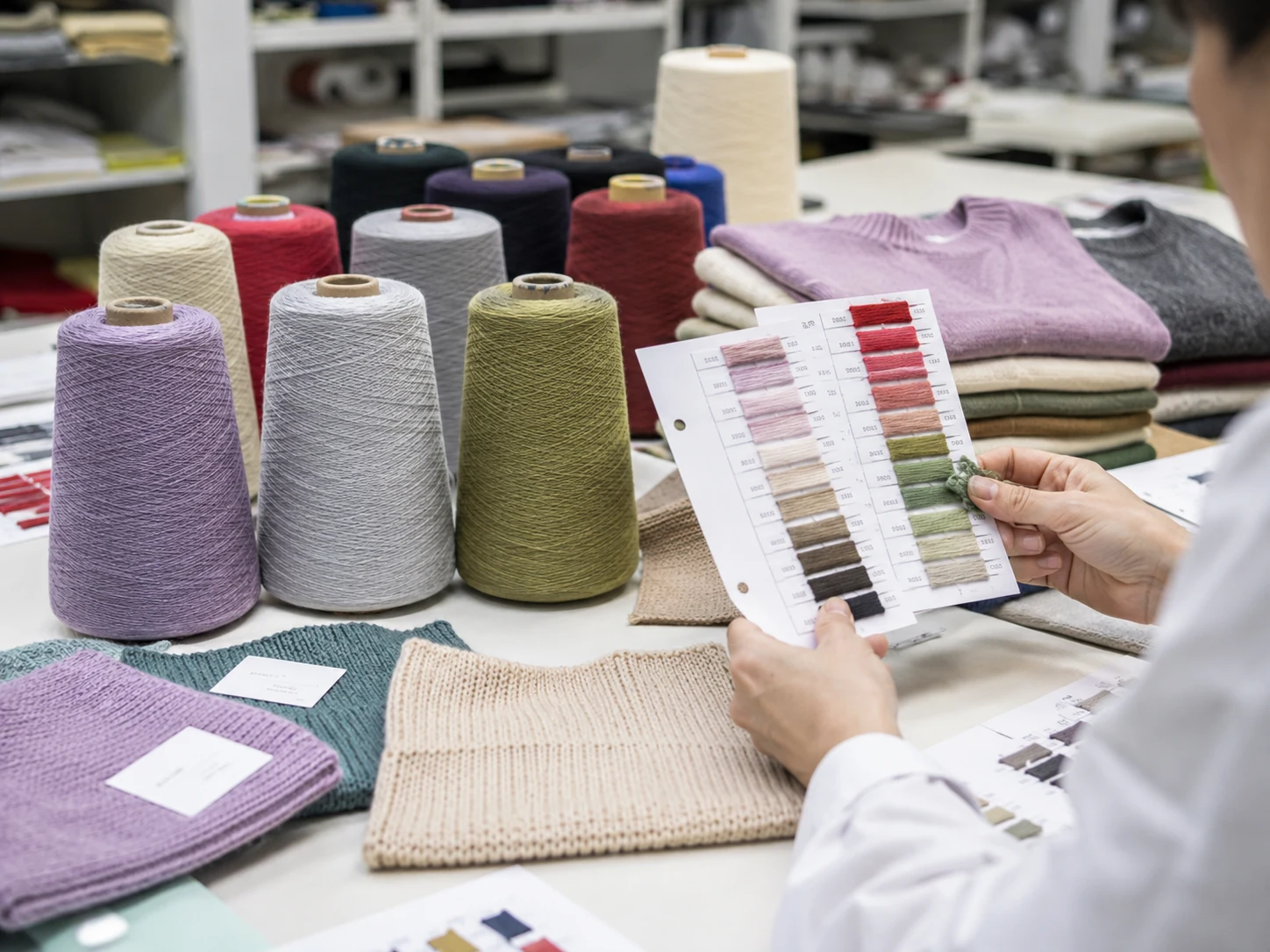
What Does MOQ Mean in Knitwear Manufacturing?
MOQ stands for Minimum Order Quantity. It is the smallest quantity a manufacturer can practically accept for a bulk production project.
From a fashion brand’s perspective, MOQ may look like a simple number. From the factory side, however, it reflects the material preparation, machine time, technician work, production setup and quality control required before finished garments can be produced consistently.
Knitwear is particularly sensitive to these requirements because sweaters, cardigans, knitted polos and knit tops are created directly from yarn.
In many knitwear projects, the fabric itself is being created while the garment panels are knitted. This is different from conventional garments that are cut from an existing roll of fabric.
This is why knitwear MOQ is closely connected to the way a garment is actually developed and manufactured.
Why Is Knitwear MOQ Calculated Per Color?
One of the most common misunderstandings among new clothing brands is assuming that a 100-piece MOQ means 100 pieces can be divided freely across several colors.
At CZ Knitwear, the standard bulk production MOQ normally starts from 100 pieces per color.
This means a style ordered in black, cream, burgundy and green is treated as four separate color production quantities, even if the garment design itself is exactly the same.
Black: 100 pcs
Total: 100 pcs
One color reaches the required 100-piece minimum.
Black: 25 pcs
Cream: 25 pcs
Burgundy: 25 pcs
Green: 25 pcs
Total: 100 pcs
Each individual color is below the 100 pcs / color MOQ.
Although both examples contain 100 finished sweaters in total, they are not treated as the same production quantity.
If the same sweater is produced in four colors, the normal starting quantity would be:
100 pcs per color × 4 colors = 400 pcs total.
1. Yarn Preparation Creates Real Production Minimums
Yarn is one of the biggest reasons knitwear behaves differently from ordinary cut-and-sew clothing.
A brand may request cotton, viscose, acrylic, wool, merino, cashmere blends or another fiber composition.
The manufacturer then needs to evaluate yarn composition, yarn count, ply, color, availability and the amount required for both sampling and bulk production.
If an existing yarn color is suitable, sourcing can be relatively straightforward. If the brand requires an exact custom shade, additional color matching or yarn dyeing may be required.
Yarn suppliers may also have their own purchasing or dyeing minimum quantities. This is one reason color quantity cannot always be treated simply as part of one combined order.
2. Gauge Changes How the Garment Is Produced
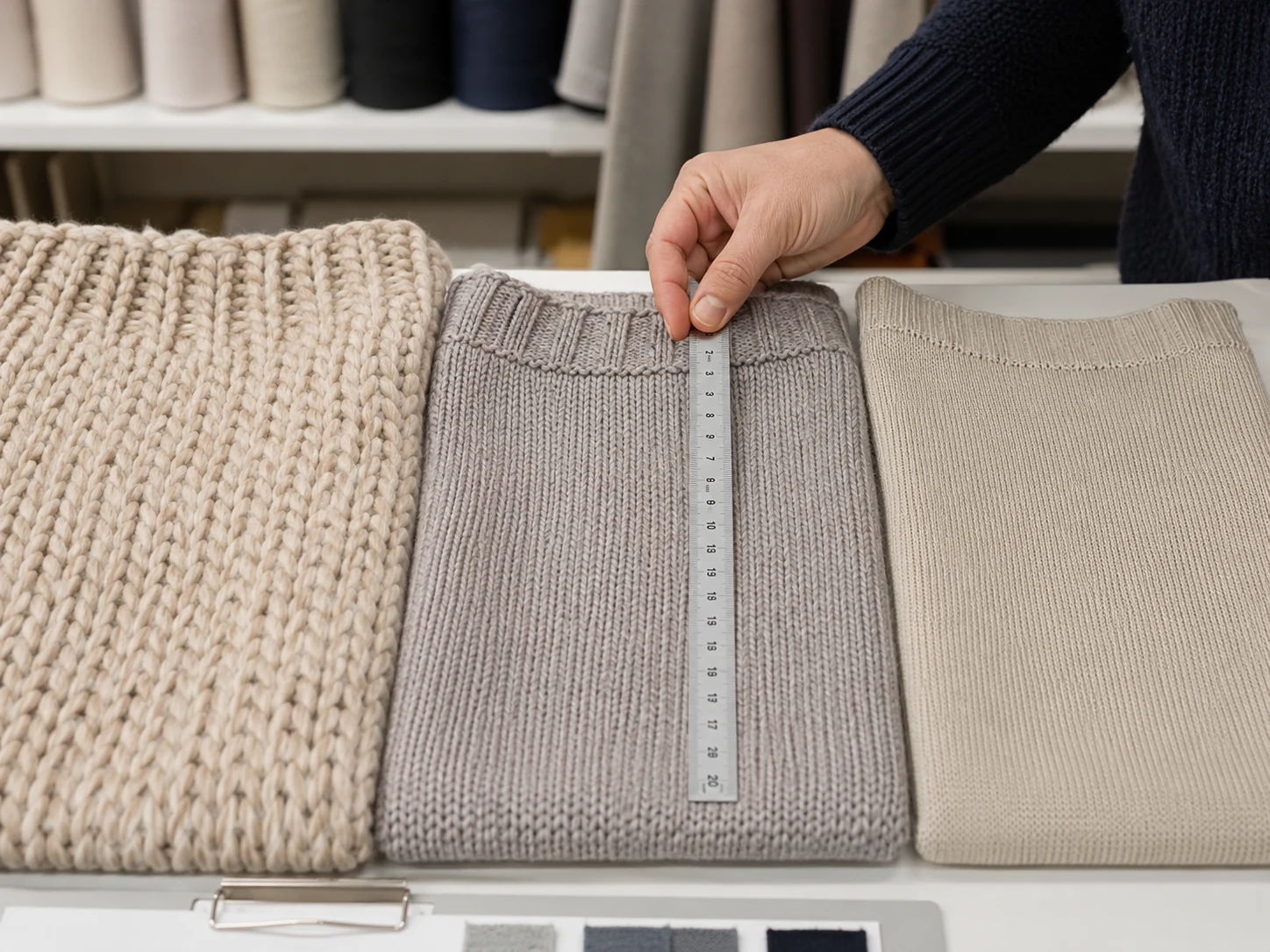
In knitwear manufacturing, gauge generally refers to the needle density of the knitting machine.
Gauge helps determine whether the finished garment has a chunky, medium or fine knitted appearance.
A heavy cable sweater and a lightweight knitted polo therefore cannot automatically be treated as the same production setup.
| Gauge | Typical Character | Common Applications | Production Consideration |
|---|---|---|---|
| 3GG–5GG | Chunky / heavier knit | Heavy sweaters, textured knitwear | Thicker yarn and greater yarn consumption |
| 7GG | Medium-weight knit | Sweaters, cardigans, knitted jackets | Balanced texture and garment weight |
| 12GG | Fine knit | Polos, knit tops, lightweight sweaters | Finer yarn and more precise machine settings |
| 14GG–16GG | Very fine knit | Fine-gauge lightweight knitwear | Fine yarn and suitable machine capability required |
Gauge itself does not determine MOQ. However, gauge works together with yarn type, garment construction, knitting complexity and available machine capacity to determine how a style should be produced.
3. Why More Colors Increase the Total Order Quantity
Adding more colors does not only change the visual collection. It creates additional material and production planning requirements.
Each color may involve a separate yarn stock, color lot, yarn preparation process and machine production batch.
If a brand requests four custom colors, each shade needs to be coordinated separately.
That is why our standard 100-piece starting quantity is applied per color.
1 color = minimum 100 pcs
2 colors = minimum 200 pcs total
3 colors = minimum 300 pcs total
4 colors = minimum 400 pcs total
For emerging brands working with a limited first-order budget, launching fewer carefully selected colors is often more practical than trying to split the same total quantity across many small color batches.
4. Knitting Machine Setup Takes Time Before Bulk Production Starts
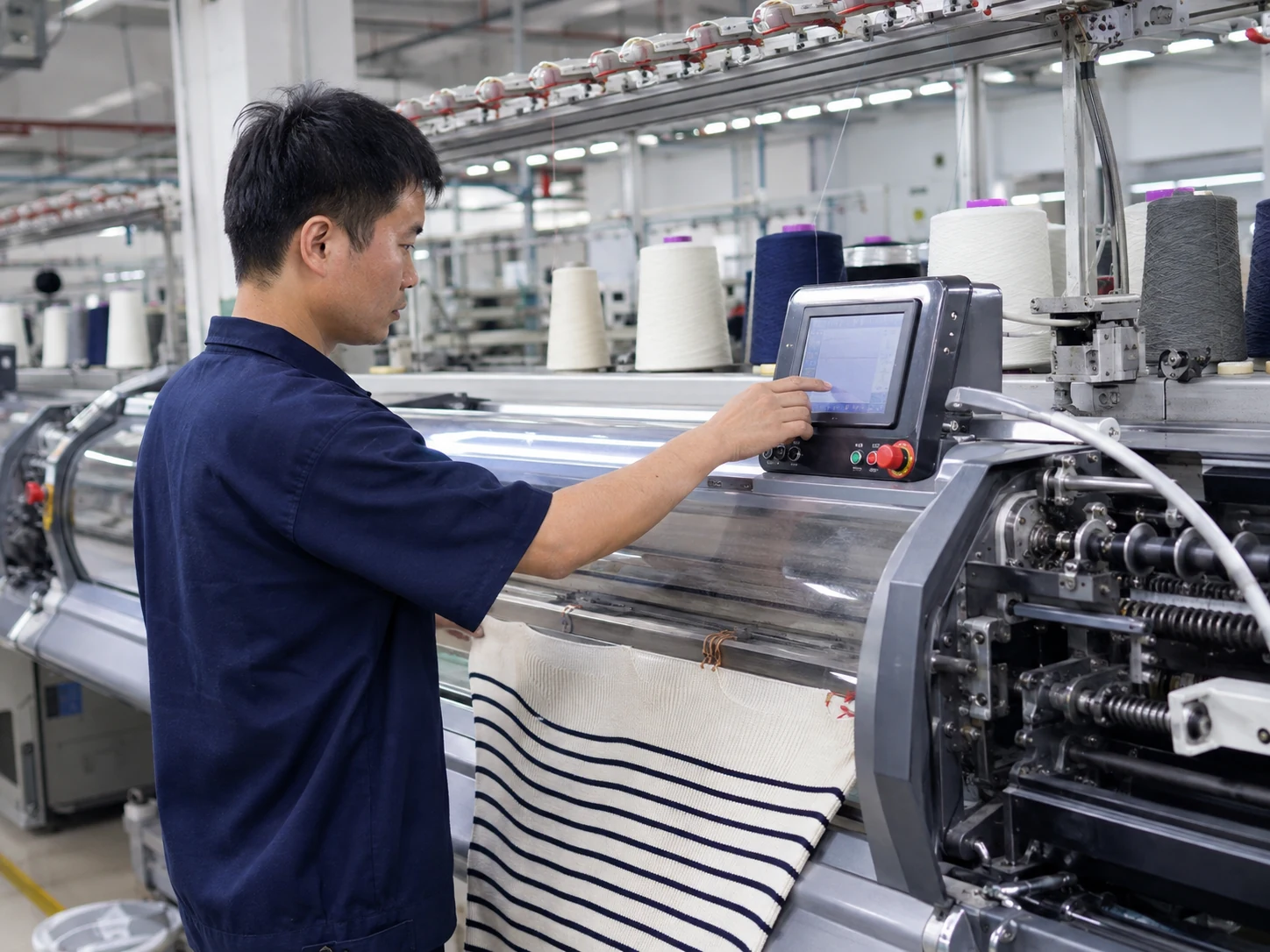
Computerized flat knitting machines make modern knitwear production highly flexible, but they still require technical preparation before a new style can enter stable bulk production.
Technicians need to translate the approved garment design into machine instructions and adjust the program according to the yarn, gauge and construction.
Depending on the style, preparation can include:
- knitting program creation or adjustment,
- stitch density settings,
- yarn tension adjustment,
- garment panel construction testing,
- rib, cable, jacquard or other structure testing,
- trial knitting,
- measurement review,
- technical corrections before bulk production.
This setup work is required even when the final production run is relatively small.
That is one reason a very small quantity such as 20 or 30 pieces per color is usually not practical for normal custom bulk production.
5. Clear Development Information Makes Production More Efficient
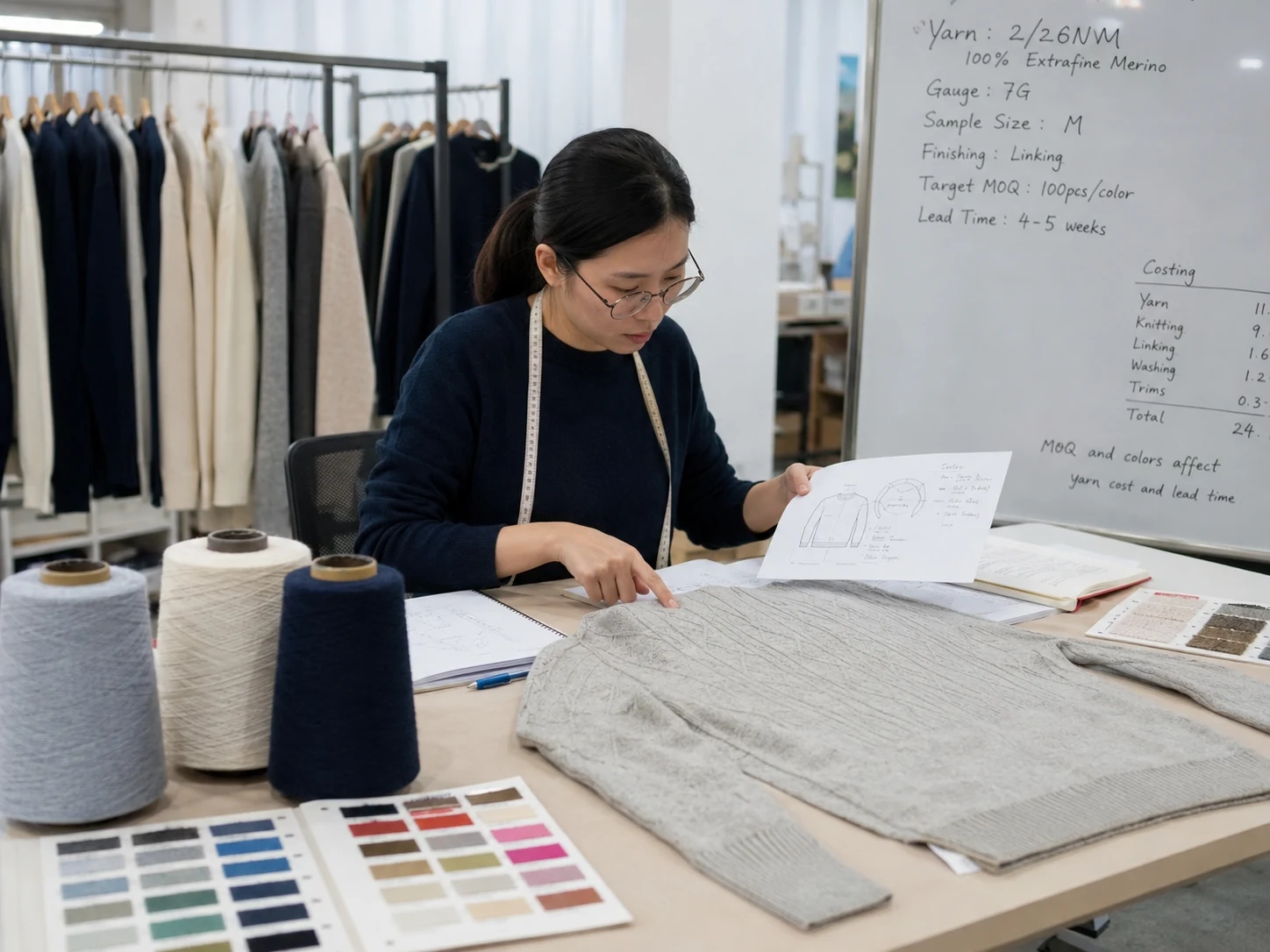
MOQ is not the only challenge in developing custom knitwear. The quality of the information provided by the buyer also affects how efficiently a style moves from concept to approved sample.
If a factory receives only one inspiration photo, many technical details still need to be confirmed before sampling can begin.
These details can include:
- yarn composition,
- target garment weight,
- gauge,
- garment measurements,
- fit and silhouette,
- knit structure,
- logo technique,
- trims,
- labels,
- packaging requirements.
A clear tech pack, measurement chart, reference garment or detailed design brief helps reduce uncertainty and unnecessary sample revisions.
What Does “Low MOQ Knitwear Manufacturer” Really Mean?
When a fashion brand searches for a low MOQ knitwear manufacturer, it is often looking for a factory that can support smaller initial production runs without requiring thousands of pieces.
But low MOQ should not be interpreted as unlimited flexibility for every color and design combination.
At CZ Knitwear, our standard bulk production starting point is 100 pieces per color.
This can be suitable for emerging brands compared with very large industrial order quantities, while still allowing the production process to be organized around custom yarn, machine programming, knitting, linking, finishing and quality control.
A Simpler Project May Include:
- available yarn compositions,
- existing yarn colors,
- relatively simple knit structures,
- fewer colorways,
- straightforward labels and packaging.
A More Complex Project May Include:
- custom yarn requirements,
- custom-dyed colors,
- complex jacquard or intarsia artwork,
- unusual garment construction,
- custom trims,
- multiple colorways,
- special washing or finishing processes.
Both projects may start from the same standard 100 pcs / color MOQ, but their development cost, lead time and unit price can be very different.
Why Low MOQ Does Not Automatically Mean Low Unit Cost
Ordering a smaller quantity can reduce a brand’s total inventory commitment, but it does not remove the technical work required before production.
Yarn sourcing, knitting programming, sample development, machine setup and quality preparation still need to take place.
When those fixed development and setup costs are divided across fewer garments, the cost per piece may be higher than it would be for a larger production run.
Instead of only asking, “Who has the lowest MOQ?”, brands should also consider the balance between production quantity, customization level, quality requirements and target unit cost.
How Startup Brands Can Reduce Knitwear Production Risk
A first knitwear collection does not need a large number of styles and colors to look complete.
In many cases, simplifying the first launch is more practical than trying to divide a small budget across too many SKUs.
Concentrating the first production budget into fewer strong designs can make sampling, production and inventory management easier.
Because MOQ is 100 pieces per color, launching one or two core colors may be more practical than beginning with four or five colorways.
Existing yarn compositions and color cards can simplify material sourcing and reduce unnecessary development complexity.
A tech pack, measurement chart, artwork, reference images or reference sample can help the factory understand the project before sampling begins.
Review measurements, yarn, color, knit structure, workmanship, labels and accessories before authorizing bulk production.
Working With CZ Knitwear
CZ Knitwear supports fashion brands, private labels and apparel companies as a knitwear manufacturing partner for custom OEM and ODM development.
Our standard custom bulk production MOQ normally starts from 100 pieces per color. We evaluate each project according to its yarn, gauge, structure, color and customization requirements before confirming production details.
- Yarn selection and sourcing
- Color development
- Gauge and knit structure evaluation
- Tech pack development support
- Custom knitwear sampling
- Logo and label customization
- Bulk production
- Quality inspection and packaging
Frequently Asked Questions About Low MOQ Knitwear Manufacturing
CZ Knitwear’s standard custom bulk production MOQ normally starts from 100 pieces per color. The quantity is calculated by color rather than only by the combined quantity of one style.
No. Ordering 25 pieces in four colors does not meet the standard bulk MOQ. Each individual color needs to reach 100 pieces. Four colors would therefore normally require 400 pieces in total.
With a standard MOQ of 100 pieces per color, two colors would normally require 100 pieces in each color, or 200 pieces total.
A 50-piece bulk production order would be below CZ Knitwear’s standard MOQ. Our custom bulk production normally starts from 100 pieces per color. Sample development is handled separately and should not be confused with bulk production MOQ.
At CZ Knitwear, the standard MOQ is calculated per color. For example, one sweater style produced in three colors would normally require 100 pieces of each color, or 300 pieces total.
Different colors require separate yarn planning, color control and production coordination. Custom-dyed yarns can also have minimum quantity requirements from yarn suppliers.
Using available yarn or existing colors can simplify material sourcing and development, but it does not normally change our standard bulk MOQ of 100 pieces per color.
A complete tech pack is helpful but is not always necessary for an initial discussion. Reference images, measurements, yarn preferences, artwork and expected order quantities can help the manufacturer evaluate your project.
Do not compare manufacturers only by the lowest advertised MOQ. Ask about yarn sourcing, available gauges, sampling capability, machine programming, knit structures, quality control and how the approved sample is translated into bulk production.
Final Takeaway
When searching for a low MOQ knitwear manufacturer, it is important to understand exactly how the manufacturer calculates its minimum quantity.
At CZ Knitwear, our standard custom bulk production MOQ normally starts from 100 pieces per color.
That means 100 pieces in one color can meet the starting MOQ, while four colors normally require at least 400 pieces in total.
Yarn availability, gauge, knit structure, machine programming, custom colors and sample development all affect how a knitwear project moves from design to production.
For emerging brands, reducing the number of initial styles and colors is often a more practical way to control inventory risk than trying to divide the MOQ into very small color quantities.
Planning Your First Custom Knitwear Collection?
Send us your reference images, tech pack or design ideas. Our team can review your yarn, gauge, color and customization requirements and help you evaluate a suitable sampling and bulk production solution.