Labeling & Compliance Guide — US & EU
Knitwear Labeling Requirements in the US and EU: A Brand Buyer’s Guide
Fiber content, care instructions, country of origin and identity of the responsible business — these are the four things a knitwear label has to get right, and the rules differ between the United States and the European Union. This guide sets out what each market requires, cites the official sources, and explains what a brand should settle with its factory before production starts.
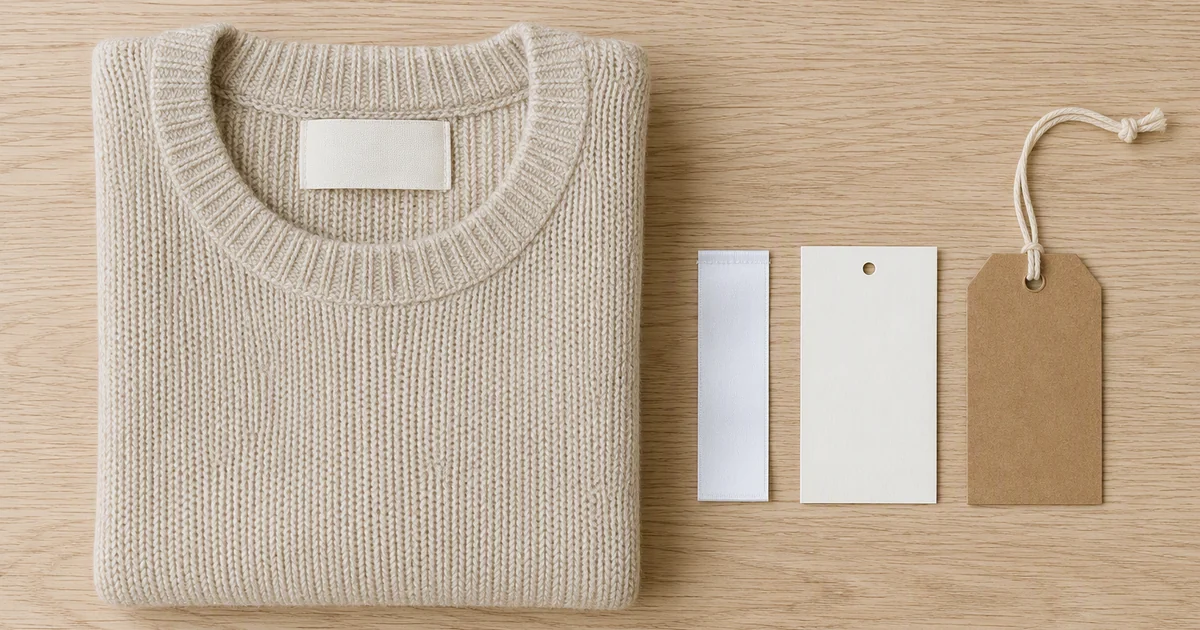
Both markets require the same core disclosure — fiber content, care information, country of origin and the identity of the business responsible — but they divide the responsibility differently and set different thresholds. The single most useful thing a brand can do is fix the label specification in writing inside the tech pack, before bulk production, rather than approving labels after the garments exist.
This guide is written for brands and bulk buyers running programmes within a mid-size OEM’s range — buyers who carry regulatory responsibility for the garments they sell, and who need to agree a workable label specification with a manufacturing partner rather than with a legal department alone.
Labeling is the one part of a knitwear programme where the factory and the brand are not interchangeable. The factory can attach a label; in most cases only the brand can decide what it says, because the obligation attaches to the business marketing the product. That makes labeling the natural final item on the development file — and the one most often left until the last minute.
This article provides general information only. It is not legal advice, and it is not a substitute for advice from your own compliance or legal team. Legal requirements change, and they can also depend on the specific fiber, product and market involved. Always check the current official sources linked in this guide — and any guidance issued since this page was written — before finalising a label or placing an order.
- Why the labeling obligation sits with the brand
- The four disclosures both markets require
- US fiber content: the five percent rule and order of predominance
- US care labeling: what the FTC rule actually requires
- Country of origin in the United States
- EU labeling under Regulation (EU) No 1007/2011
- Side-by-side: where the two markets differ
- The EU product safety layer above labeling
- What to ask your factory for
- Writing the label specification into the tech pack
- Label and compliance checklist
- Frequently asked questions
1. Why the Labeling Obligation Sits With the Brand
The most common misunderstanding in knitwear development is that the factory “handles the labels”. A factory can print, supply and attach labels. It cannot decide what the label says on your behalf, because the obligation follows the product into the market under the name of the business marketing it.
That distinction explains a specific provision in the US rules: a person marketing or handling textile fiber products who directs a processor or finisher to label a product with required information is responsible for any failure of compliance arising from what they directed, without relieving the processor or finisher of their own duty (16 CFR § 303.2). In practice: you cannot delegate the content of the label to the factory. You can delegate the execution.
The label specification belongs in the same document as the measurement specification — the tech pack — and it should be agreed before sampling, not after bulk. A label approved at packing stage is expensive to correct and cannot be corrected invisibly.
2. The Four Disclosures Both Markets Require
Across both the United States and the European Union, a knitwear label is answering the same four questions. The wording and thresholds differ, but the structure does not:
Fiber content
What the garment is made of, expressed as generic fiber names with percentages by weight, in a defined order.
Care information
How the garment should be washed, dried, ironed, bleached or drycleaned — and what must not be done to it.
Country of origin
Where the product was processed or manufactured, which for imports is determined under customs rules.
Responsible business
The identity of the manufacturer or of another business responsible for marketing or handling the item — a company name or a registered identification number.
The FTC’s own business guidance summarises the US position in a single sentence: federal labeling requirements for textile and wool products require that most of these products have a label listing the fiber content, country of origin and identity of the manufacturer or another business responsible for marketing or handling the item, with care labels for clothing required by a separate FTC rule (FTC, Threading Your Way Through the Labeling Requirements Under the Textile and Wool Acts).
Where the FTC guidance addresses hang-tags, it is worth a brand’s attention: certain hang-tags may disclose fiber names, trademarks and non-deceptive performance information without disclosing the product’s full fiber content — but unless the tag states the full fiber content, or the product is made entirely of that fiber, the tag must clearly and conspicuously tell potential buyers that there is more to know, for example “This tag does not disclose the product’s full fiber content” or “See label for the product’s full fiber content.” A performance hang-tag on a knitwear programme is therefore not a free space.
3. US Fiber Content: The Five Percent Rule and Order of Predominance
In the United States, fiber content disclosure is governed by the FTC’s rules under the Textile Fiber Products Identification Act, at 16 CFR Part 303. The required information on the label includes the following (16 CFR § 303.16):
- The generic names and percentages by weight of the constituent fibers present in amounts of 5 percent or more, excluding permissive ornamentation
- Those fibers listed in order of predominance by weight, with any fiber required to be designated as “other fiber” or “other fibers” appearing last
- The name or registered identification number of the manufacturer, or of one or more persons marketing or handling the product
- The name of the country where the product was processed or manufactured
Fibers below five percent
This is the rule that most often surprises brands, and it is explicit in the regulation. Under 16 CFR § 303.3, a fiber present in an amount of less than 5 percent of the total fiber weight shall not be designated by its generic name or fiber trademark — it shall be designated as “other fiber”. Where more than one such fiber is present, they are designated in the aggregate as “other fibers.”
The same section provides a limited exception: nothing prevents disclosing a fiber present in a small amount where it has a clearly established and definite functional significance when present at that amount. The example given in the regulation is a product disclosed as 96 percent acetate and 4 percent spandex. Read the other way round, the exception is narrow — it is about functional significance, not about marketing appeal.
A trace of elastane, a small percentage of a luxury fiber, or a minor recycled component can all fall under the 5 percent threshold. If the design intent is that a fiber appears on the label by name, the fiber percentage has to be designed and specified to clear the threshold — not discovered at label approval.
Three further points from the same part are worth knowing when the label is drafted: required information must be set out in English (16 CFR § 303.4); the part separately addresses the prohibition of abbreviations, ditto marks and asterisks (§ 303.5) and the use of the terms “All” or “100%” (§ 303.27); and the rules on how required information is arranged and disclosed on the label sit in § 303.16 itself.
4. US Care Labeling: What the FTC Rule Actually Requires
Care labeling in the United States is a separate FTC rule — the Care Labeling of Textile Wearing Apparel and Certain Piece Goods, at 16 CFR Part 423. Its core requirement for apparel is set out in 16 CFR § 423.6.
Attachment
Manufacturers and importers must attach care labels so that they can be seen or easily found when the product is offered for sale to consumers. If the product is packaged, displayed or folded so that customers cannot see or easily find the label, the care information must also appear on the outside of the package or on a hang tag fastened to the product.
Content
Care labels must state what regular care is needed for the ordinary use of the product. In general, a label must carry either a washing instruction or a drycleaning instruction — only one is needed if either method is suitable. If the product cannot be cleaned by any available method without being harmed, the label must say so. The detail requirements include:
- Washing — whether hand or machine wash, and a water temperature expressed in terms such as cold, warm or hot. If regular use of hot water up to 145 °F (63 °C) will not harm the product, no temperature needs to be stated.
- Drying — whether by machine or another method, plus a drying temperature where machine drying applies. If a high temperature will not harm the product, no drying temperature needs to be stated.
- Ironing — mentioned only where it will be needed on a regular basis to preserve appearance, or where a warning requires it.
- Bleaching — no mention needed if all commercially available bleaches are safe; where all would harm the product the label must say “No bleach” or “Do not bleach”; where only chlorine bleach would harm it, the label must say “Only non-chlorine bleach, when needed.”
- Warnings — where a procedure consumers may reasonably use would harm the product, a clear warning using words such as “Do not”, “No” or “Only.”
- Drycleaning — where a drycleaning instruction is included, it must also state at least one type of solvent that may be used, unless all commercially available solvents are suitable. The terms “Drycleanable” or “Commercially Dryclean” may not be used in an instruction.
The requirement brands most often miss
Section 423.6(c) requires that a manufacturer or importer establish a reasonable basis for the care information by processing prior to sale — that is, reliable evidence behind the instruction, whether from testing, from technical literature, from past experience, or from other reliable evidence, and including where the label is silent as to a particular method. A care instruction is not a marketing preference. It is a claim that has to be supported before the product is sold.
This is directly relevant to a brand sourcing knitwear: the evidence behind a care instruction sits with whoever knows how the garment behaves in use. That is a question to settle with the factory during development, not at packing — which is one of the reasons the sample approval checklist belongs alongside the label specification.
5. Country of Origin in the United States
Origin disclosure appears twice in a US knitwear programme, and the two references work together.
First, the FTC rules require origin on the label: each imported textile fiber product shall be labeled with the name of the country where it was processed or manufactured, and the same section sets out how products made wholly or partly in the United States are to be described (16 CFR § 303.33). The FTC guidance explains that the country where an imported product is processed or manufactured is the country of origin as determined under the laws and regulations enforced by Customs — which is why a label claim and a customs determination must agree.
Second, the customs side is codified separately: 19 CFR Part 134 sets out the regulations implementing the country of origin marking requirements of section 304 of the Tariff Act of 1930, as amended (19 U.S.C. 1304).
Origin is determined by where the product was processed or manufactured under customs rules — not by where the yarn was spun, where the design was made, or where the brand is registered. In a programme where knitting, making-up and finishing may not all happen in the same place, origin is a question to confirm in writing rather than assume from the yarn’s country of origin.
6. EU Labeling Under Regulation (EU) No 1007/2011
The European Union’s instrument for fiber composition is Regulation (EU) No 1007/2011 of the European Parliament and of the Council of 27 September 2011 on textile fibre names and related labelling and marking of the fibre composition of textile products (OJ L 272, 18.10.2011, pp. 1–64). Its rules are more prescriptive than the US framework in several places, and three of them matter most for knitwear.
Only listed fiber names may be used
Under Article 5, only the textile fiber names listed in Annex I may be used for the description of fiber compositions on labels and markings, and use of those names is reserved for fibers whose nature corresponds to the description in that Annex.
“100%”, “pure” and “all” are protected terms
Under Article 7, only textile products exclusively composed of the same fiber may be labeled or marked as “100 %”, “pure” or “all”, and those terms may not be used for other products. The same article allows a product containing no more than 2 percent by weight of extraneous fibers to be treated as exclusively composed of the same fiber, provided that quantity is justified as technically unavoidable in good manufacturing practice.
Descending order, and the “other fibers” allowance
Under Article 9(1), a textile product must be labeled or marked with the name and percentage by weight of all constituent fibers in descending order. A derogation in Article 9(2) allows a fiber accounting for up to 5 percent of total weight — or fibers collectively accounting for up to 15 percent — to be designated by the term “other fibres”, immediately preceded or followed by their total percentage by weight, where they cannot easily be stated at the time of manufacture.
This is a useful contrast with the US position. Both markets have a small-fiber allowance, but the EU framework is built around an exhaustive list of permitted fiber names and a descending-order disclosure of all constituent fibers, with a numeric purity threshold for “100 %” claims.
How the label itself must be made
Under Article 14(1), textile products must be labeled or marked to give an indication of their fiber composition whenever they are made available on the market, and the labeling and marking must be durable, easily legible, visible and accessible — and, in the case of a label, securely attached. Article 14(2) allows labels or markings to be replaced or supplemented by accompanying commercial documents when products are supplied to economic operators within the supply chain, which is relevant to a brand buying from a factory and shipping onward. Article 16(1) extends the requirement into catalogues and trade literature, packaging, labels and markings, in print that is uniform as regards size, style and font.
For a product built from more than one textile component with different fiber contents, Article 11 requires a label or marking stating the fiber content of each component — a point that matters for knitwear with a woven contrast panel, a different-fiber trim, or a lined component.
Sources: Regulation (EU) No 1007/2011 — Articles 5, 7, 9, 11, 14 and 16. Care labeling in the European Union is governed separately from fiber composition and is outside the scope of this guide; confirm the position for your market before finalising a care label.
7. Side-by-Side: Where the Two Markets Differ
| Point of comparison | United States | European Union |
|---|---|---|
| Instrument for fiber composition | FTC rules under the Textile Fiber Products Identification Act (16 CFR Part 303) | Regulation (EU) No 1007/2011 |
| Permitted fiber names | Generic names prescribed by the rules (§ 303.7); separate provisions govern fiber trademarks | Only the fiber names listed in Annex I of the Regulation |
| Disclosure of constituents | Generic names and percentages by weight for fibers present in amounts of 5 percent or more, in order of predominance | Name and percentage by weight of all constituent fibers, in descending order |
| Small-fiber treatment | Fibers under 5 percent designated “other fiber” / “other fibers” (§ 303.3), with a narrow functional-significance exception | Fibers up to 5 percent, or collectively up to 15 percent, may be designated “other fibres” where they cannot easily be stated at the time of manufacture (Art. 9(2)) |
| Purity claims | Use of “All” or “100%” addressed in § 303.27 | “100 %”, “pure” or “all” reserved for exclusively composed products, with a 2 percent extraneous-fiber allowance (Art. 7) |
| Care information | Separate FTC rule: Care Labeling of Textile Wearing Apparel and Certain Piece Goods (16 CFR Part 423), including a reasonable-basis requirement in § 423.6(c) | Governed separately from fiber composition; not covered by this guide |
| Country of origin | Required on the label (§ 303.33), with origin determined under customs laws and regulations; customs marking codified at 19 CFR Part 134 | Not addressed by the fiber-composition instrument cited here |
| Physical quality of the label | Rules on label placement and attachment (§§ 303.15, 303.16) | Must be durable, easily legible, visible, accessible and securely attached (Art. 14(1)) |
| Language | Required information must be in English (§ 303.4) | Governed by the Regulation and by national requirements in each member state |
| Where the information must appear | Label, or invoice in defined circumstances; advertising also subject to the rules | Label or marking, and also catalogues and trade literature (Art. 16(1)); commercial documents may supplement in supply-chain sales (Art. 14(2)) |
The practical reading: a single label design rarely satisfies both markets without adjustment. The EU requirement to state all constituent fibers in descending order is more granular than the US 5 percent threshold, and the EU’s reserved “100 %” language is a defined term rather than a general claim. A programme selling into both markets generally needs either two label versions or one label written to the stricter standard — and the choice should be made deliberately, not by default.
8. The EU Product Safety Layer Above Labeling
Fiber composition is only one part of what a product must satisfy before it can be placed on the EU market. Sitting alongside labeling rules is the EU’s general product safety framework — Regulation (EU) 2023/988 of the European Parliament and of the Council of 10 May 2023 on general product safety — which addresses the obligations of economic operators, including providers of online marketplaces, and provides for penalties set by member states.
For a knitwear brand, the practical consequence is that labeling compliance and product safety compliance are two separate workstreams that both need to be closed before a programme ships. A label can be perfectly drafted and the product still not be marketable if the safety obligations have not been addressed. Because the specific obligations depend on the product and the distribution channel, this is a question for your own compliance team rather than for a manufacturer — but it is worth confirming early which side of the programme owns it, because it is not a factory decision.
9. What to Ask Your Factory For
Most of what a brand needs from a manufacturing partner in this area is documentation, not certification. The items below are document types that can be agreed in the development file, and none of them requires the factory to hold a particular credential:
- A written fiber composition breakdown per style — the constituent fibers and their percentages by weight, stated the same way on every document, so the label, the invoice and the specification cannot drift apart.
- The care instructions the factory recommends, with the basis for them — because the US rule requires a reasonable basis for care information before sale, the discussion is about evidence rather than preference.
- Confirmation of where the product is processed or manufactured — the fact that origin labeling and customs marking both depend on.
- The label and branding specification — label placement, care label position, hangtag copy, packaging copy, and who applies size and origin marking.
- A guaranty passed from supplier to buyer, where applicable — the FTC rules set out forms of separate guaranty and continuing guaranty from seller to buyer (§§ 303.36 and 303.37) and make provision for continuing guaranty filed with the Commission (§ 303.38), together with record-keeping obligations (§ 303.39).
- Confirmation of how label replacement is handled — the FTC guidance addresses replacing another company’s label with your own, which is exactly the situation in a private label programme where the garment leaves the factory under your brand rather than the manufacturer’s.
Two practical points on the last item. First, in a private label programme the brand’s name — or its registered identification number — is normally the identity that appears on the label, which is why the identity question has to be settled with the factory’s label supplier rather than assumed. Second, where a hangtag is used for performance claims rather than full fiber content, the disclosure requirement described in section 2 applies.
Where a programme is being built from the ground up, the wider document set is covered in what to send a knitwear manufacturer before requesting a quote and knitwear tech pack requirements.
10. Writing the Label Specification Into the Tech Pack
The reason labeling goes wrong is rarely that the rule is unknown. It is that the label is treated as a purchasing task rather than a specification item. These five steps move it into the development file where it belongs.
US-only, EU-only and dual-market programmes produce different label requirements. Settle which markets the style is for at specification stage, because the answer can change the fiber composition you need — not just the wording.
Confirm the percentages by weight and check them against the small-fiber rules in each market. If a fiber needs to appear by name, the composition has to be designed to clear the threshold rather than discovered at label approval.
Decide whether the label carries the brand’s name or a registered identification number, and confirm with the label supplier that it can be produced that way. Do this before the labels are printed, not after.
Agree the care wording together with the basis for it, and record where that basis sits. This is a documentation step, and in the US market it is a requirement rather than a courtesy.
Record where each label goes, how it is attached, what the hangtag says, and the point at which artwork is frozen. Labels are applied late in production, so a change after the freeze is a change to finished goods.
Steps 1 and 2 are the ones that affect the garment itself; steps 3 to 5 affect only the label. Handling them in that order means the expensive decisions come first, while they are still cheap to change.
11. Label and Compliance Checklist
Before a knitwear style goes into bulk production, confirm each line:
- Markets — the destination markets are stated, and the label requirements have been checked against each one
- Fiber composition — constituent fibers and percentages by weight are agreed in writing and match the production specification
- Threshold check — small-fiber amounts have been tested against the applicable threshold in each market, and any fiber intended to appear by name clears it
- Permitted fiber names — the names used on the label are permitted in each destination market
- Purity claim — any “100 %”, “pure” or “all” claim is justified by the composition and the applicable allowance
- Care information — care wording is agreed, and the basis for it is documented
- Care label placement — the label can be seen or easily found when the product is offered for sale, with package or hangtag placement where the garment is folded or bagged
- Country of origin — origin wording matches the country where the product is processed or manufactured under the applicable customs determination
- Responsible business identity — the name or registered identification number on the label is correct and approved
- Label quality — labeling is durable, legible, visible and securely attached where that standard applies
- Hangtags — any performance hangtag that does not state full fiber content carries the required disclosure
- Artwork freeze — the point at which label artwork is frozen is agreed, and changes after it are treated as changes to finished goods
12. Frequently Asked Questions
What must a knitwear label show in the United States?
Under the FTC’s textile labeling rules, most textile and wool products must carry a label stating the fiber content, the country where the product was processed or manufactured, and the identity of the manufacturer or another business responsible for marketing or handling the item. Clothing care information is required by a separate FTC rule, the Care Labeling Rule at 16 CFR Part 423.
How is fiber content shown when a fiber is under five percent?
Under 16 CFR § 303.3, a fiber present in an amount of less than five percent of the total fiber weight is not designated by its generic name or fiber trademark but as “other fiber”. When more than one such fiber is present they are designated in the aggregate as “other fibers”. There is a limited exception where a fiber present in a small amount has a clearly established and definite functional significance. In the EU, Article 9(2) of Regulation (EU) No 1007/2011 provides a comparable allowance for fibers up to 5 percent, or collectively up to 15 percent, where they cannot easily be stated at the time of manufacture.
What are the fiber labeling rules in the European Union?
Regulation (EU) No 1007/2011 governs textile fiber names and the labeling of fiber composition. Only the fiber names listed in its Annex I may be used. Multi-fiber products must state the name and percentage by weight of all constituent fibers in descending order, and labeling must be durable, easily legible, visible, accessible and securely attached.
When can a product be labeled 100 percent or pure in the EU?
Under Article 7 of Regulation (EU) No 1007/2011, only textile products exclusively composed of the same fiber may be labeled or marked as “100 %”, “pure” or “all”. A product containing no more than two percent by weight of extraneous fibers may also be treated as exclusively composed of the same fiber, provided that quantity is justified as being technically unavoidable in good manufacturing practice.
Who is responsible for the label — the brand or the factory?
The obligation attaches to the business marketing or handling the product under its own name, which is normally the brand rather than the factory. Manufacturers and importers must attach care labels, and the US rules make a person who directs a processor or finisher to label a product responsible for any failure of compliance arising from what they directed. A factory can produce and attach a label; it cannot take on the content decision for you.
What documents should a brand ask the factory for?
Useful items include a written fiber composition breakdown for each style, the care instructions the factory recommends together with the basis for them, confirmation of where the product is processed or manufactured for origin labeling, the branding and label specification itself, and where applicable a guaranty passed from the supplier to the buyer. These are document types rather than certifications, and they can be agreed in the development file.
Related Knitwear Manufacturing Resources
- Knitwear tech pack requirements — what a complete specification contains
- What to send a knitwear manufacturer before requesting a quote — the inputs that make a programme priceable and buildable
- Private label knitwear from tech pack to bulk production — where the brand’s own label enters production
- Knitwear sample approval checklist — the gate before bulk production
- The knitwear sampling process — from tech pack to approved production sample
- Custom knitwear cost guide — what actually drives a quotation
- OEM vs ODM vs private label knitwear — which model fits your brand
- Evaluating knitwear quality — testing quality claims against evidence
- Low MOQ knitwear manufacturing — what determines the workable minimum
- OEM knitwear manufacturing process — what happens after the specification is agreed
- OEM / ODM knitwear development — how we develop from brief to bulk
- Our process — the six-step development workflow
Building a Labeling Plan Into Your Next Knitwear Order
Send us your tech pack, reference garment or reference image along with the destination markets for the style. We will come back on the fiber composition and gauge direction, the label and branding specification, the workable order conditions and the production timeline — and confirm in writing what the label needs to state before sampling begins.
Founded in 2006, CZ Knitwear develops and manufactures custom sweaters, cardigans, knit tops and knit accessories across 3GG–22GG gauges for brands and bulk buyers running programmes within a mid-size OEM’s range. Apparel production typically starts from 100 pcs per colour; knit accessories, pet knitwear and baby & kids knitwear typically start from 300 pcs per colour.
Request a Quote — With the Label Specification Agreed Up Front
Share your tech pack, reference image or sample photo together with the destination markets. We will confirm the fiber and gauge direction, the care and origin information the label needs, the workable order conditions and the lead time — and put it in writing before sampling. Request a production quote or contact us on WhatsApp.
Request a Quote & Let’s Create Together
Send us your tech pack, reference image or sample photo. Our team will review MOQ, yarn, gauge, sample timing and bulk production plan.
FAQ
What is your MOQ?
Apparel MOQ from 100 pcs / style. Pet Knitwear & Knit Accessories MOQ from 300 pcs / style.
How long does sampling take?
Sampling usually takes 7–15 days. The fastest sample lead time can be around 7 days depending on style complexity, yarn availability and workmanship.
How long is bulk production?
Bulk production usually takes 12–45 working days after sample approval, depending on order quantity, yarn, gauge, workmanship and packaging requirements. Typical ranges: 100 pcs 12–15 working days, 300 pcs 15–25 working days, 500–1,000 pcs 25–45 working days. Final schedule depends on yarn availability, stitch structure and order quantity.
Can you work from photos?
Yes. We can develop custom knitwear from tech packs, reference photos, original samples or design ideas.
Do you support custom labels and packaging?
Yes. We support private label, hangtag, care label, poly bag, carton packing and export-ready packaging.