OEM / ODM / Private Label — Model Selection Guide
OEM vs ODM vs Private Label Knitwear: Which Model Fits Your Brand
Most knitwear sourcing problems that look like production problems are actually model problems. Before you compare factories or ask for a quotation, one question has to be settled: who owns the design? This guide explains what each model really means in knitwear, how they differ on control, cost and timeline, and how to choose the right one for your brand’s stage.
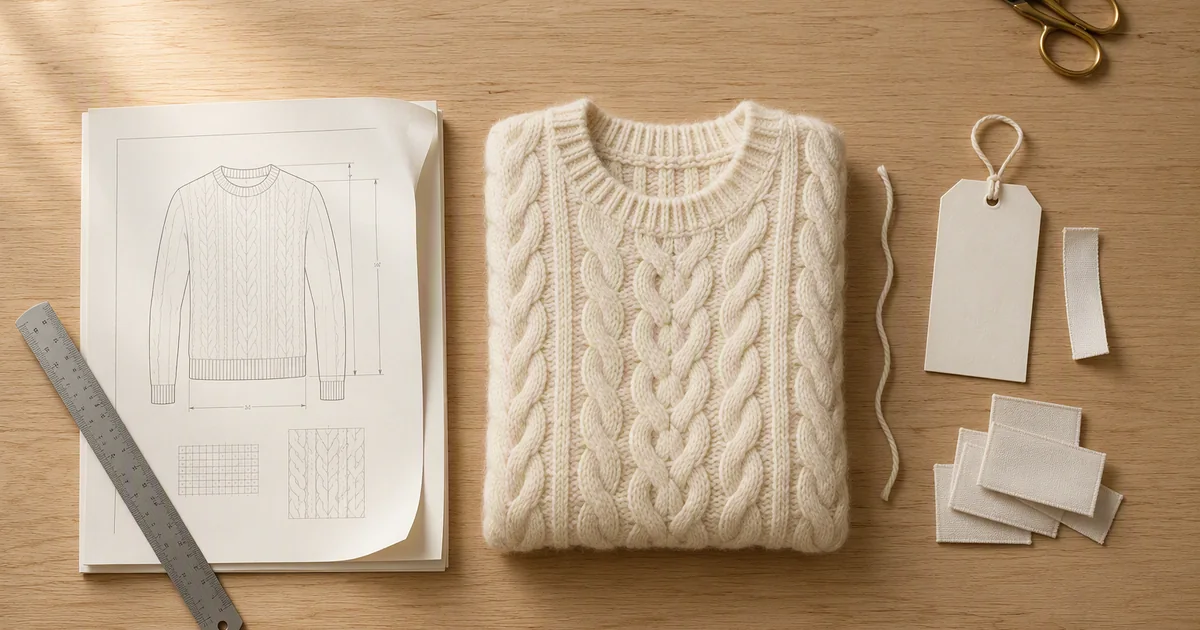
OEM, ODM and private label are not three sizes of the same order. OEM and ODM describe who owns the design; private label describes who owns the brand on the finished garment. Brands that skip this distinction usually discover the mismatch after sampling, when the pattern, the exclusivity or the development cost is already committed.
Knitwear buyers often use “OEM”, “ODM” and “private label” as if they were interchangeable labels for “a factory that makes our sweaters”. In practice they describe two different things that get mixed together, and the mix-up is expensive — because it only surfaces once sampling is under way.
This guide separates the two axes, compares the models on the dimensions that actually change your project, and ends with a five-step process and a checklist you can use before you request a quotation.
- What OEM, ODM and private label actually mean in knitwear
- The one question that decides the model: who owns the design?
- How the three models compare side by side
- How each model changes your development timeline
- Where cost actually moves between the models
- What each model means for control and risk
- Matching the model to your brand’s stage
- A five-step decision process
- Model selection checklist
- Common mistakes when choosing a knitwear production model
- Frequently asked questions
1. What OEM, ODM and Private Label Actually Mean in Knitwear
The terminology is genuinely ambiguous, and that ambiguity is documented rather than imagined. The standard definition of an original equipment manufacturer notes that the term is “ambiguous, with several other common meanings” and is frequently used interchangeably with original design manufacturer and original brand manufacturer (see the OEM terminology reference). That confusion travels directly into knitwear sourcing conversations.
Stripped of the noise, each term answers a different question.
OEM — the brand owns the design
In knitwear, OEM production means the brand supplies the design and the specification, and the manufacturer produces to it. You provide the tech pack, the measurements, the construction details, the colour direction and the branding requirements. The factory is responsible for making the garment the way you specified it, at the quality level you specified, on the schedule you agreed.
The design, the pattern and the specification belong to the brand. That is the point of the model.
ODM — the manufacturer owns the design
ODM production reverses the origin of the design. The manufacturer develops the style — sometimes from its own seasonal range, sometimes newly engineered for you — and the brand selects, adapts and brands it. Yarn, colour, gauge, trims, labelling and finishing are still customised to your collection, but the starting design is the factory’s work (ODM definition).
This is why ODM is often described as faster: the hardest part of development — turning an idea into a workable knit construction — has already been solved.
Private label — a separate axis entirely
Private label does not answer “who designed it”. It answers “whose brand is on it”. A private label garment carries your label, your hangtag and your packaging rather than the manufacturer’s. Because that is a branding decision rather than a design decision, private label production can sit on top of either an OEM or an ODM base — and many programmes run both at once, with the hero styles developed as OEM and the filler styles adapted from ODM designs.
OEM
You bring the design and the specification. The factory builds to your pattern. Highest control over construction, fit and exclusivity — and the most development work sits on your side.
ODM
The factory brings the design. You adapt yarn, colour, gauge, trims and branding. Fastest route to a first sample — but the style may not be exclusive to you.
Private Label
A branding layer, not a design model. Your labels, hangtags and packaging go onto production that was developed either as OEM or as ODM.
Hybrid
The realistic default for most growing brands. Hero styles run as OEM for control; seasonal filler runs as ODM for speed. Both carry your private label.
2. The One Question That Decides the Model: Who Owns the Design?
Almost every model disagreement resolves once you can answer two sub-questions precisely:
- What do you already own? A finished design with measurements and construction details is a different starting point from a mood board, a reference image, or a competitor garment you want to adapt.
- Who should own the result? If the pattern and the specification become an asset you want to reuse across seasons, you need them to belong to you. If the style is a one-off for a single season, ownership matters less than speed.
If you own a complete specification, OEM is the natural fit. If you do not, you are choosing between ODM and a hybrid — not between “OEM” and something inferior. There is no ranking here. There is only a match, and the match is determined by what you already have in hand.
A sample produced under ODM assumptions and later expected to behave like an OEM style will need re-patterning, re-measuring and re-approval — which is the same work as starting over, only paid for twice. Confirming the model first is the cheapest control you have.
3. How the Three Models Compare Side by Side
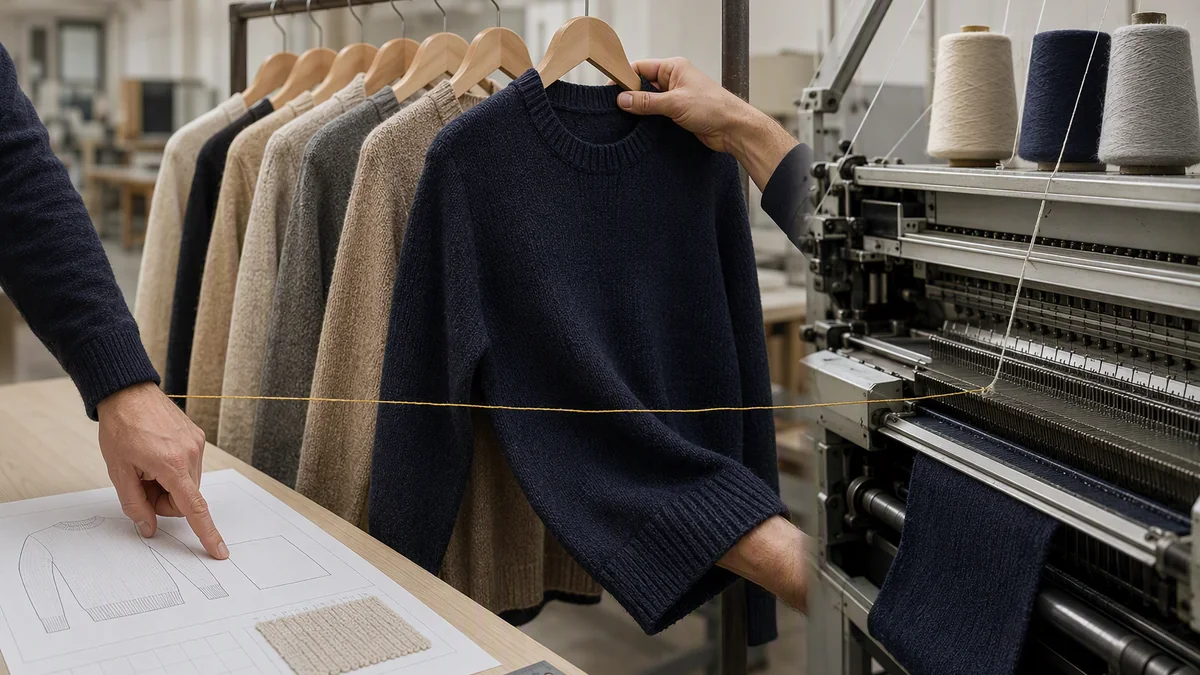
The table below compares the models on the dimensions that change a real knitwear development programme. Read it as a set of trade-offs, not a scorecard.
| Dimension | OEM | ODM | Private Label layer |
|---|---|---|---|
| Who designs the style | The brand | The manufacturer | Not applicable — this is a branding layer |
| Who owns the pattern & spec | The brand | Usually the manufacturer | Unchanged by the label |
| What you send to start | Tech pack, measurements, construction, reference garments | Design direction, reference images, target market, brand requirements | Label artwork, hangtag, packaging specification |
| Starting point of the first sample | Pattern development from your specification | Adaptation of an existing or newly developed design | Production already specified |
| Development work on your side | Highest — the specification is yours to complete | Lower — the construction already exists | Lowest — branding and presentation only |
| Exclusivity of the style | Yours, subject to the agreement | Must be requested and stated; not automatic | Determined by the underlying model |
| Reuse across seasons | Pattern and specification carry forward | Depends on what the manufacturer permits | Not affected |
| Best suited to | Brands with in-house design and a clear specification | First collections, trend-led ranges, speed-to-market | Any brand selling under its own name |
4. How Each Model Changes Your Development Timeline
The models differ less in total lead time than in where the time goes — and in who absorbs the risk if the first sample misses.
ODM: the construction is already solved
The longest phase of knitwear development is turning an idea into a working construction — deciding yarn count, gauge, stitch structure, density and shaping, then proving they behave together on a machine. In an ODM programme that work has already been done, so your first sample starts from a known construction and your revisions focus on colour, fit adjustments, trims and branding.
OEM: the construction is the project
In an OEM programme that phase is yours. Your specification has to be translated into a pattern, knit structures have to be tested against your yarn and gauge, and the first sample is a real development milestone rather than a confirmation. It takes longer, and it produces something you own.
Where the calendar is the same
Once a sample is approved, both models converge. At CZ Knitwear, sampling typically takes 7–15 days depending on style complexity, and bulk production normally runs 12–45 working days after sample approval. Those windows do not change because you chose OEM over ODM — what changes is how many sample rounds you need to get to approval in the first place. Development time you do not spend before sampling is usually paid back in revision rounds after it.
5. Where Cost Actually Moves Between the Models
Cost questions about OEM and ODM almost always start in the wrong place. The right question is not “which model is cheaper” but “what is included in each quotation”.
What ODM typically bundles
Because the design already exists, an ODM quotation usually avoids a separate full development charge. What it may still carry is a pattern or tooling element, a minimum colour or quantity condition tied to that style, and — the item buyers most often overlook — a limit on exclusivity. If a style is not exclusive to you, the same construction can appear in another brand’s range. That is a commercial cost, not a line item, and it is worth pricing in consciously.
What OEM typically shifts to you
OEM production moves development upstream to the brand: pattern making, construction testing, fit revisions, specification documentation. That is more work before production, and it is also where the value accumulates — the pattern and specification remain yours and can be reused, reordered and extended across seasons without paying to solve the same problem again.
Why a cheap quote is often not a comparable quote
Two manufacturers can quote the same reference sweater while assuming different yarn composition, yarn count, garment weight, gauge, stitch density, size set, colour allocation, trims, labelling and packaging. When those assumptions differ, the two numbers are not alternatives — they are answers to different questions. Before comparing anything, confirm the basis of each quotation, which is exactly what a complete knitwear tech pack allows a supplier to price against. If your development file is still open, start with what to send a knitwear manufacturer before requesting a quote.
The cost driver that surprises buyers most
Order structure frequently moves cost more than the model does. Yarn purchasing and machine setup are driven by colour count and quantity per colour, not by total order size alone. At CZ Knitwear, apparel production typically starts from 100 pcs per colour, while accessories, pet knitwear and baby & kids knitwear typically start from 300 pcs per colour. A brand comparing an eight-colour programme against a three-colour programme at the same total quantity is comparing very different production realities — regardless of whether the style is OEM or ODM.
6. What Each Model Means for Control and Risk
The control question is not “how much say do I get”
It is “what do I still control after the first sample is approved?” Every model gives you a say during development. What separates them is the reference point that governs bulk production.
- OEM — bulk production is governed by your written specification plus the approved sample. If the two ever diverge, you have a document to point at.
- ODM — bulk production is governed by the approved sample and the factory’s construction. Your control runs through the approved sample and the agreed colour and trim specification.
- Private label — adds a third reference point: branding. Label placement, hangtag copy, care information and packaging all have to be specified, because they are usually applied last and are the hardest to correct afterwards.
The practical consequence is that the number of reference points you control goes up as you move from ODM to OEM — and so does the amount of documentation you are responsible for. Choosing OEM without being ready to maintain a specification is a common way to end up with the cost of control and none of the benefit.
Materials documentation follows the same logic. Buyers with compliance obligations — particularly for baby & kids ranges or for markets with restricted-substance rules — should establish at the selection stage which yarn and material documentation will travel with the goods, and in what form. Recognised material certification schemes such as OEKO-TEX Standard 100 sit on the material side of that question, and where certification is required it should be named in the specification rather than assumed at packing.
Quality control is where the model difference shows up last and matters most. Whatever the model, the approved sample has to be transferred into bulk production against written criteria — measurements, workmanship, colour and finishing — and checked against them. Our knitwear sample approval checklist sets out the checks worth agreeing before bulk starts.
7. Matching the Model to Your Brand’s Stage
Model choice tracks the brand’s stage far more than it tracks the product category. Four common situations:
First collection, no in-house design
ODM or hybrid. You need a working construction faster than you need to own one. Start from existing designs, adapt yarn, colour, gauge and branding, and learn how the product behaves in production.
Design team in place, clear specification
OEM. You already produce the hardest input — the specification. OEM converts that into a pattern you own and can reorder without redeveloping.
Retailer or marketplace seller
Private label on either base. What matters is that the label, hangtag, care information and packaging specification are fixed early, and that the underlying model is chosen per style.
Scaling a proven style
OEM with pattern ownership. Once a style sells, owning the pattern removes the redevelopment cost from every reorder and protects the fit your customers already buy.
Most brands do not choose one model for the whole business. They choose per style, and the mix shifts as the brand matures. A programme running OEM hero styles and ODM seasonal filler under a single private label is a normal and healthy structure — not a compromise. CZ Knitwear supports all three, including multi-gauge development from 3GG to 22GG and full private label customisation across labels, hangtags and packaging.
8. A Five-Step Decision Process
Use this sequence before you approach a manufacturer. It takes less time than one unnecessary sample round.
List what exists: complete tech pack, measurements, construction details, reference garments, or only a direction and reference images. This single inventory usually determines the model.
OEM puts pattern development, construction testing and fit revisions on your side. Confirm you have both the budget and the people to own that work before choosing it.
If the style is your differentiator, exclusivity is a requirement to state up front. If it is a seasonal filler, a non-exclusive ODM style may be the faster and cheaper answer.
Assign a model per style. Hero pieces and reorders usually justify OEM; trend-driven and one-season pieces usually justify ODM. Both can carry your label.
Record which model applies, what the brand supplies, what remains open, who owns the pattern, how revisions are controlled, and which order conditions apply. Then sample.
Step 05 is the one buyers skip. It is also the cheapest step in the entire process.
9. Model Selection Checklist
Before you send a development request, confirm each line:
- Design origin — stated as brand-owned (OEM) or manufacturer-owned (ODM) for this specific style
- Pattern ownership — who holds the pattern and the specification, and what that means for reorders and future seasons
- Exclusivity — requested explicitly, with the scope and duration agreed rather than assumed
- Branding layer — neck label, care label, hangtag, packaging and logo treatment specified for private label
- Development inputs — tech pack, measurements, reference garments or design direction, with open points identified
- Quotation basis — yarn, construction, size set, colour allocation, trims, branding and order volume all stated
- Order structure — quantity per colour confirmed alongside total quantity
- Sample control — how comments are recorded and how revisions are tracked against the latest approved specification
- Bulk reference — the approved sample plus the written specification that governs production
- Documentation — which yarn and material documents are required and in what form
For the development inputs specifically, a complete knitwear tech pack guide and our private label workflow from tech pack to bulk production cover the detail behind these lines.
10. Common Mistakes When Choosing a Knitwear Production Model
- Treating private label as a production model. It is a branding layer. Choosing “private label” does not tell a factory whether to develop a pattern for you or not.
- Assuming ODM means no customisation. Yarn, colour, gauge, trims, sizing and branding are all specified by the brand in an ODM programme. The difference is the origin of the design, not the degree of customisation.
- Assuming OEM automatically means exclusive. Exclusivity is a commercial term, not a consequence of the model. It has to be requested and agreed.
- Comparing quotations from different models. An ODM quote that includes a pattern the factory already owns is not comparable to an OEM quote that includes building one.
- Choosing OEM without a specification. The model transfers documentation responsibility to the brand. Without that capacity, OEM adds cost without adding control.
- Settling the model after sampling. The most expensive version of this decision is the one made once the sample is already on the table.
11. Frequently Asked Questions
What is the difference between OEM, ODM and private label in knitwear?
OEM and ODM describe who owns the design. In OEM production the brand supplies the design and specification and the factory manufactures to it. In ODM production the manufacturer develops the design and the brand applies its own branding. Private label describes who owns the brand on the finished garment rather than who designed it, so private label production can run on top of either an OEM or an ODM model.
Which knitwear production model is cheaper?
Cost depends on what is included, not on the label of the model. ODM styles usually avoid a full development charge because the design already exists, but you may pay pattern or tooling costs and the style may not be exclusive to you. OEM production usually carries more development work up front because the pattern, fit and construction are built for your specification. A quotation is only comparable when both sides are priced on the same yarn, construction, size set, colour allocation, trims, branding and order volume.
Do I need my own design to work with a knitwear manufacturer?
No. If you do not have a complete design, an ODM or hybrid approach lets you start from an existing or newly developed design and adapt yarn, colour, gauge, branding and finishing to your collection. If you have a tech pack, measurements and reference garments, an OEM approach usually gives you closer control over the specification.
Can private label knitwear also be OEM production?
Yes. Private label describes whose brand appears on the garment, while OEM and ODM describe where the design comes from. A brand can run private label production on an OEM base, on an ODM base, or on a mixed model where some styles are developed for the brand and others are adapted from existing designs.
What should be confirmed in writing before sampling starts?
Confirm which model applies to the style, who owns the design and the pattern, what the brand is supplying, which development points remain open, how sample revisions are controlled, how branding and packaging are specified, and what order conditions apply. Settling these points before sampling avoids paying for samples that were built on different assumptions. Our knitwear sampling process walks through the full sequence from tech pack to approved production sample.
Which model should a first collection use?
A first collection usually benefits from an ODM or hybrid approach, because development cost and risk are lower while the brand still learns how yarn, gauge, fit and finishing behave in production. Brands with an in-house design team and a clear specification often move to an OEM model once their first styles are proven.
Related Knitwear Manufacturing Resources
- OEM / ODM knitwear development — how we work across both models
- OEM knitwear manufacturing process — what happens after the model is chosen
- Custom sweater manufacturing — from tech pack or reference image to bulk
- Low MOQ knitwear manufacturing — how order minimums are actually determined
- Knitwear gauge guide, 3GG to 22GG — how gauge changes product and cost
- Knitwear sourcing outlook — how brands are evaluating suppliers
- Our process — the six-step development workflow
Choose the Model Before You Request the Quote
Send us your tech pack, reference image or sample photo together with the model you think fits — OEM, ODM, private label or a mix. Our team will review the development route, the yarn and gauge direction, the workable order conditions and the production timeline for that specific style, and confirm in writing which model applies before sampling begins.
Founded in 2006, CZ Knitwear develops and manufactures custom sweaters, cardigans, knit tops and knit accessories across 3GG–22GG gauges for brands in Europe and North America.
Request a Quote — and Tell Us Which Model You Want
Share your tech pack, reference image or sample photo. We will come back on the development route, yarn and gauge direction, order conditions and production timeline — and confirm the model in writing before sampling. Request a production quote or contact us on WhatsApp.
Request a Quote & Let’s Create Together
Send us your tech pack, reference image or sample photo. Our team will review MOQ, yarn, gauge, sample timing and bulk production plan.
FAQ
What is your MOQ?
Apparel MOQ from 100 pcs / style. Pet Knitwear & Knit Accessories MOQ from 300 pcs / style.
How long does sampling take?
Sampling usually takes 7–15 days. The fastest sample lead time can be around 7 days depending on style complexity, yarn availability and workmanship.
How long is bulk production?
Bulk production usually takes 12–45 working days after sample approval, depending on order quantity, yarn, gauge, workmanship and packaging requirements. Typical ranges: 100 pcs 12–15 working days, 300 pcs 15–25 working days, 500–1,000 pcs 25–45 working days. Final schedule depends on yarn availability, stitch structure and order quantity.
Can you work from photos?
Yes. We can develop custom knitwear from tech packs, reference photos, original samples or design ideas.
Do you support custom labels and packaging?
Yes. We support private label, hangtag, care label, poly bag, carton packing and export-ready packaging.