Sizing & Fit Guide — US & EU
Knitwear Sizing and Fit for the US and EU: A Size Chart and Grading Guide for Brands
A size chart is not a document a factory hands over — it is the brand’s own commercial specification, and the factory produces to it. This guide explains the difference between body measurements and garment measurements, why knitted garments behave differently from cut-and-sewn ones, and how a brand and a factory should agree a size specification before sampling rather than after bulk production.
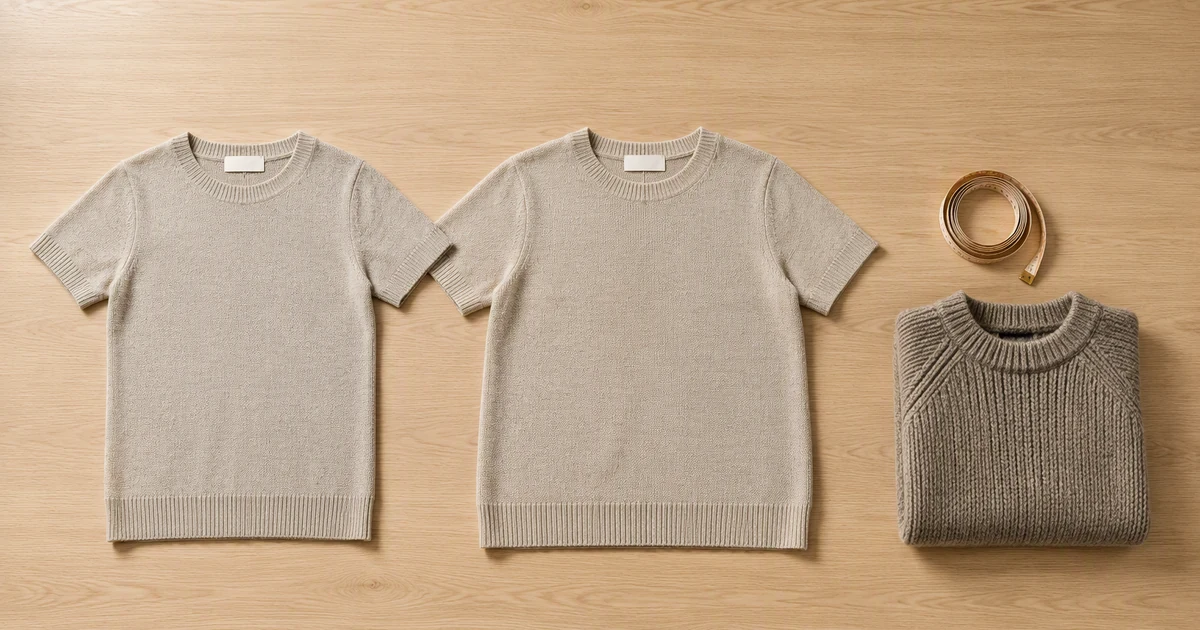
Sizing is not a disclosure a factory owes you — it is a specification you own. Two published standards cover two different things: body measurement tables and intervals, and garment dimension measurement. Most size chart failures come from treating the first as if it were the second. Fix the measurement method and the measurement points in writing before sampling, and the rest of the sizing conversation becomes mechanical.
This guide is written for brands and bulk buyers running programmes within a mid-size OEM’s range — buyers who carry the fit and returns consequence of a size chart that does not hold, and who need to agree a workable size specification with a manufacturing partner rather than with a spreadsheet alone.
One thing is worth stating at the outset, because it removes a lot of confusion: a size chart is the brand’s specification, not the factory’s deliverable. The factory’s job is to produce to the specification consistently. Deciding what the specification should be — which size set, which measurement points, which fit — is a commercial decision that belongs to the brand.
This article provides general information only. It is not legal advice and not a standards interpretation. Sizing systems, fit expectations and requirements vary by market, product category and brand, and this guide deliberately does not publish measurement values, grading increments or tolerances — those belong to your own specification and to the standards you choose to work to. Always refer to the current official standards and to your own brand’s fit data before finalising a size chart or placing an order.
- Why sizing is a specification, not a disclosure
- Body measurements and garment measurements are two different things
- Who owns the size chart — and what the factory actually needs
- What a usable size chart contains
- Grading: what it is, and where increments should come from
- Why knitted garments behave differently from cut-and-sewn
- Fit, drape and the return-rate problem
- How to verify a size chart before bulk
- Size chart and fit checklist
- Frequently asked questions
1. Why Sizing Is a Specification, Not a Disclosure
It helps to start from what is actually regulated. On a US textile label, the required disclosures are fibre content, the identity of the business responsible and the country where the product was processed or manufactured (16 CFR § 303.16) — with care information required separately. In the EU, the instrument governing fibre composition sets out fibre names and how composition must be stated (Regulation (EU) No 1007/2011).
Garment sizing is not among those required disclosures. That is not an oversight — it reflects what sizing is. A size label is a commercial promise about fit, not a mandatory product fact. It answers a question the market asks (“will this fit?”) rather than a question the regulator asks (“what is this made of?”).
The practical consequence matters commercially. Because sizing is not a disclosure, nobody outside your brand can be held responsible for a size chart being wrong — and nobody outside your brand can define what “right” means for your customer. If the fit is wrong, the returns land with the brand.
This is the opposite of the labelling position covered in our US and EU labelling guide, where the obligation attaches to a defined list of required information and the brand must be able to evidence it. Sizing is different: the requirement is not imposed, it is chosen. Which is exactly why it needs a process.
2. Body Measurements and Garment Measurements Are Two Different Things
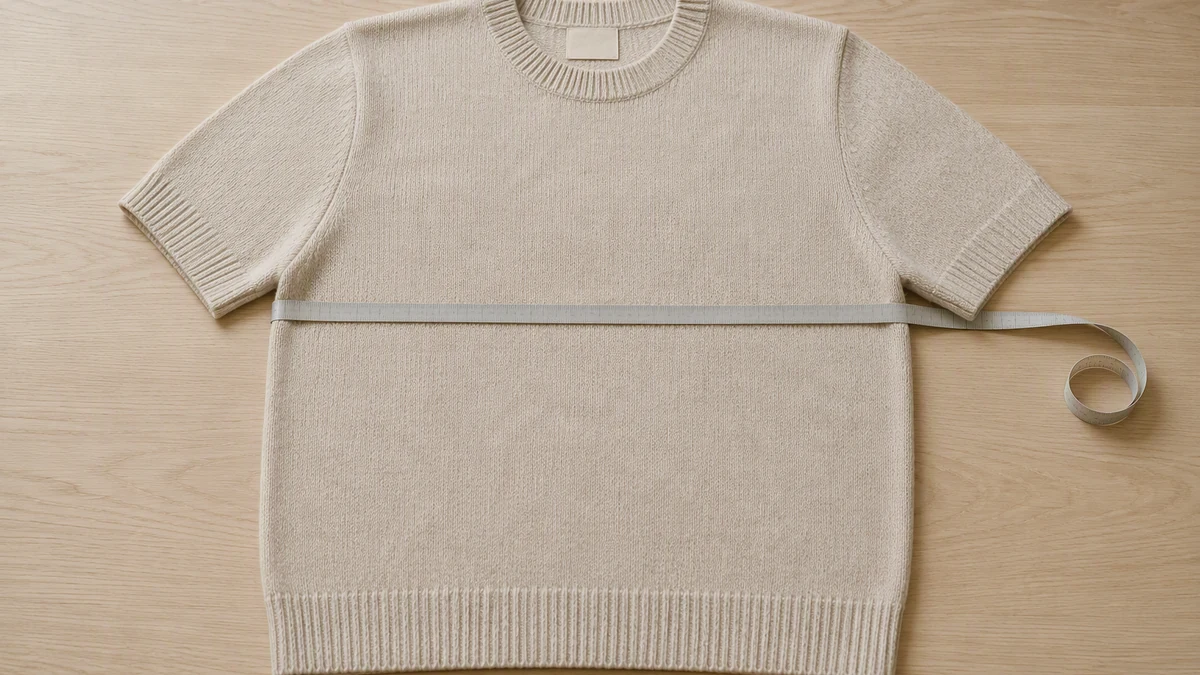
This is the single most useful distinction in the whole subject, and the published standards draw it explicitly.
Body measurement
The measurements taken on a person, and the tables and intervals built from population data. Covered by the ISO 8559-1:2017 anthropometric definitions and the ISO 8559-3:2018 methodology for body measurement tables and intervals.
Garment measurement
The measurements taken on the finished garment, and how they are taken. Covered by a separate standard, ISO 18890:2018, which defines the main measurement points and the method used to measure garment dimensions.
The distinction is not a matter of interpretation — the standards state it themselves. The abstract of ISO 8559-3:2018 records plainly that “Garment dimensions are not included in this document.” Body measurement tables are an input. Garment dimensions are the output the factory is judged against.
A second sentence from ISO 18890:2018 is just as practically important. After defining the main measurement points, it notes that “Additional measurement points can be determined between interested parties.” In other words, the standard provides a shared vocabulary and a method — and it expects the parties to agree the specifics. That is what a size chart negotiation actually is.
When a size chart is sourced from a generic body measurement table and handed to a factory as though it were a garment specification, the two parties are talking about different objects. The garment will be produced, measured and rejected against a table that was never a garment spec. The fix is not better measuring — it is agreeing which layer you are working in.
Both layers sit inside the same standardisation framework: the ISO committee responsible for this work, ISO/TC 133, defines its scope as the standardisation of a system of size designations, body size measurement methods for clothing and for digital garment fitting — with separate working groups for body measurement, digital fitting and measurement indicators.
Sources: ISO/TC 133 · ISO 8559-1:2017 · ISO 8559-3:2018 · ISO 18890:2018
3. Who Owns the Size Chart — and What the Factory Actually Needs
Because sizing is not a regulated disclosure, the ownership question has a clear answer: the size chart belongs to the brand, and the factory manufactures to it.
This surprises buyers who expect a manufacturer to supply a size chart for them. It is worth being precise about what a manufacturer can and cannot do:
- Can: measure garments against your specification; tell you what a proposed size set will do on a given yarn, gauge and stitch structure; flag where a construction will make a measurement unstable; produce a graded size set to your increments; and measure the approved sample so the specification can be corrected.
- Cannot: decide what your customer’s body dimensions are; decide what fit your brand promises; or take on the commercial consequence of a size chart that does not match your market.
At CZ Knitwear, the size specification is treated as a brand input. We develop and produce to the size chart and fit you supply, and we will push back on points that a given yarn, gauge or stitch structure cannot hold reliably — but we do not define your brand’s sizing. That is a deliberate boundary: a factory that invents your size chart has taken over a decision it cannot be accountable for.
What the factory does need from the brand, before sampling, is a size specification complete enough to produce and measure against. The next section sets out what that contains.
4. What a Usable Size Chart Contains
A size chart is not a table of numbers. It is a specification whose value lies in what it defines. The same table with a missing definition produces a rejected shipment that everybody blames on the factory.
| Element | What it defines | What goes wrong without it |
|---|---|---|
| Measurement points | Which points on the garment the specification refers to, named consistently | Two people measure the same garment and report different results; nothing can be signed off |
| Measurement method | How each point is measured — flat or on a form, relaxed or extended, folded or laid | The sample passes and the bulk fails, because they were measured two different ways |
| Size set | Which sizes the programme covers and how the range is intended to sit | The range has gaps or overlaps; core sizes sell out while the ends of the range remain unsold |
| Grading basis | Where the increments between sizes come from and how they were derived | The garment fits the middle of the range and drifts at the ends — where most returns come from |
| Fit intent | How the garment is meant to sit — close, regular, relaxed, oversized | The garment is technically correct and commercially wrong, because “correct” was never defined |
| Reference samples | Which physical sample is the authority in a dispute | Every later measurement argument has no baseline to resolve against |
| Fit mannequin or form | Which form the garment was developed on and evaluated against | Fit decisions cannot be reproduced in a later season or by a second supplier |
| Change control | How and when the size specification may be amended, and by whom | Sizes shift quietly between seasons, and repeat business no longer fits the same customers |
Notice that only one of those eight rows involves actual numbers. The other seven are definitions. In practice, most rejected shipments are argued about the numbers when the real disagreement is in the definitions.
Before sampling, agree in writing how each measurement point is taken. It is a short conversation, it costs nothing, and it removes the single most common cause of size-related disputes between a brand and a factory.
5. Grading: What It Is, and Where Increments Should Come From
Grading is the process of scaling a garment between sizes so that the range behaves like one coherent product rather than a set of separate garments. The mechanism is simple — a base size plus increments. The judgement is not.
Three sources of increments, in descending order of reliability
- Your own fit data — what your customers actually wear, buy and return. Slowest to assemble, best aligned with your market, and the only source that is genuinely yours.
- Your target population data — body measurement tables built from population data for the market you sell into. This is where the ISO 8559 work sits: ISO 8559-2 covers primary and secondary dimension indicators, and ISO 8559-3 sets out a methodology for creating body measurement tables and intervals. Note that ISO 8559-3 states plainly that values in its tables are examples, and that garment dimensions are not part of it.
- A generic table borrowed from elsewhere — the default when nobody wants to do the work, and the main reason a range can be perfectly made and still fit nobody.
The middle option is the one most brands should understand better than they do. A population table tells you about bodies. It does not tell you how your garment should measure at each size, because that depends on the yarn, the structure, the fit intent and how much ease you have chosen. The table is an input to your thinking, not a substitute for it.
Where grading actually goes wrong
Grading errors are quiet. A range can look correct on paper, pass a fit session in the middle of the size set and fail at both ends. The three recurring faults:
- Linear grading applied to a garment that does not scale linearly. Bodies do not scale uniformly, and a knitted structure does not either. Applying one increment rule across the whole range produces a garment that is right in the middle and wrong at the extremes.
- Grading a measurement point that should not be graded. Some points are intended to stay fixed across a size range, and moving them changes the garment’s identity rather than its fit.
- Grading without re-checking the knit. A change in width or length can change how a rib, cable or openwork structure behaves, so the graded size is not simply a scaled version of the base.
The practical discipline is to treat the extremes of the size range as seriously as the middle. Fit sessions that only evaluate a central size will not reveal the errors that generate returns.
6. Why Knitted Garments Behave Differently from Cut-and-Sewn
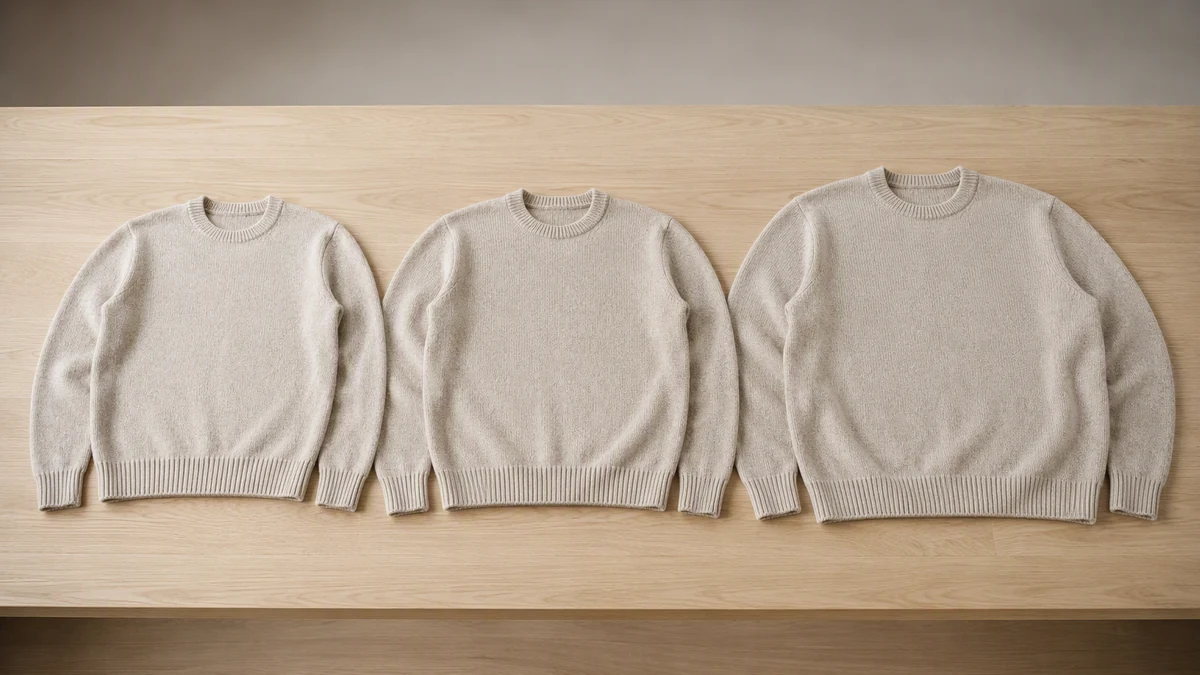
In cut-and-sewn production, fabric is made first and cut afterwards. In knitting, the fabric is the garment — the stitch structure is created as the panel is formed. That single difference explains most of the fit instability that surprises brands moving into knitwear.
- Relaxation after knitting. A knitted piece can change dimension after it comes off the machine, as the yarn settles into its natural stitch configuration. Measuring immediately after knitting and measuring after the piece has rested are not the same measurement.
- Handling and finishing effects. Washing, pressing and steam treatments move knitted dimensions. Two identical garments from the same batch can measure differently depending on when and how each one was handled.
- Stitch structure behaviour. A plain knit, a rib, a cable and an openwork structure each behave differently under the same tension. Rib structures in particular are designed to contract, so their flat and relaxed states differ — which is exactly why the measurement method has to be specified rather than assumed.
- Gauge and yarn interaction. Finer gauges and softer yarns produce a lighter, more mobile fabric; coarser gauges produce a heavier, more stable one. CZ Knitwear develops across 3GG to 22GG, and the same size specification can read very differently at the two ends of that range.
- Construction method. Whole-garment knitting removes linking and some panel seams, which changes how the finished piece hangs and where its measurement points naturally sit. The comparison is set out in whole-garment vs traditional knitting.
- Drape and weight. A heavier knitted garment hangs differently under its own weight, so a garment measured flat and a garment measured hanging can disagree — and neither is wrong.
None of this means knitted sizing is unpredictable. It means the specification has to say when and how the garment is measured, not only what the target is. That is a one-line addition to your tech pack and it prevents an entire category of dispute.
7. Fit, Drape and the Return-Rate Problem
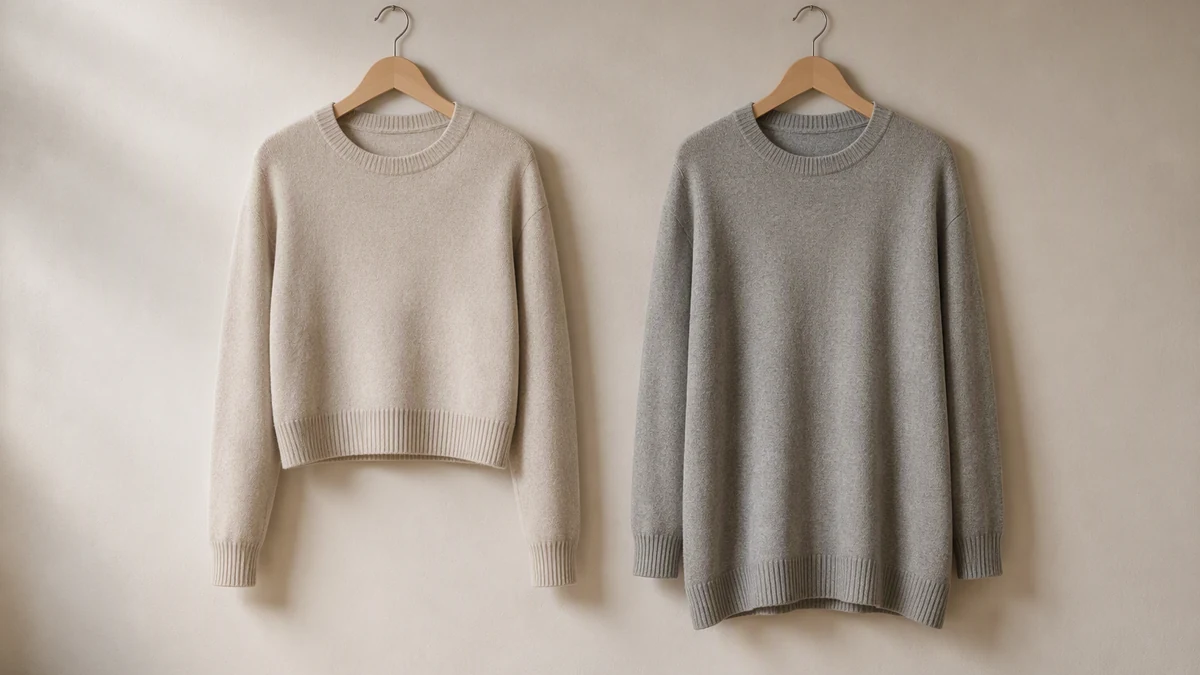
For a brand, sizing is ultimately a returns question. A size chart that is technically satisfied and commercially wrong produces returns, and returns in knitwear are disproportionately driven by fit rather than by defect.
Three fit decisions that a size chart cannot express on its own, and that therefore need to be written down separately:
- Ease and intended fit. How much room the garment is meant to have over the body is a design decision, not a measurement. Without it recorded, a factory can produce exactly to your numbers and still deliver something that does not match your customers’ expectation of the same size label.
- Where the fit is meant to be forgiving. A relaxed knit and a close-fitting knit have different tolerances for movement, and they fail differently — one looks shapeless, the other binds. Which failure is worse is a brand decision.
- Consistency across the range. Customers buy a brand’s size, not a garment’s size. If the same label sits differently across two styles in the same collection, the range is generating returns even when every individual size chart is correct.
This is why fit intent belongs in the same document as the measurements. A size chart with no fit intent is a set of numbers with no promise attached — and the promise is the part the customer is buying.
8. How to Verify a Size Chart Before Bulk
The order of these five steps matters more than the steps themselves: each one is cheaper than the one after it.
Write down which points the specification uses and exactly how each one is taken on a knitted garment — flat or hanging, relaxed or extended, before or after the defined resting period. Do this before any sample is measured.
State which sizes the programme covers and how the garment is meant to sit in each. A size set without fit intent cannot be evaluated, only measured.
Ask the factory which points a given yarn, gauge and stitch structure can hold consistently, and which will move. This is a technical conversation, and it is the factory’s most useful contribution.
The approved sample is the baseline. Measure it using the agreed method, record the results, and amend the size chart to match reality rather than arguing the sample against the original table.
Fit-check the smallest and largest sizes in the range. Grading errors are invisible in the middle of a size set and obvious at the ends.
Steps 1 and 3 are where most programmes save the most money. Both are conversations rather than costs — and both happen before anything has been made.
9. Size Chart and Fit Checklist
Before a knitwear style goes into bulk production, confirm each line:
- Ownership — it is clear that the size chart is the brand’s specification, and the factory is producing to it
- Measurement points — every point is named and defined, and the names match across the tech pack, the size chart and the inspection documents
- Measurement method — the method for each point is written down, including flat or hanging, relaxed or extended, and any resting period before measuring
- Size set — the range is defined, with no gaps or unintentional overlaps
- Grading basis — the source of the increments is known, and it is the brand’s own fit data or a documented population basis rather than an unexplained table
- Fit intent — how the garment is meant to sit is recorded for each size, not only for the base size
- Yarn and structure check — the factory has confirmed which points the specified yarn, gauge and stitch structure can hold reliably
- Extremes evaluated — the smallest and largest sizes have been fit-checked, not only a central size
- Reference sample — the approved sample is identified, retained and treated as the authority
- Fit form recorded — the mannequin or form the style was developed on is documented for future seasons
- Cross-style consistency — the same size label sits consistently across the styles in the collection
- Change control — how the size specification can be amended, by whom, and at what point it freezes
10. Frequently Asked Questions
Is there a required size chart a factory must supply?
No. Unlike fibre content, country of origin and the identity of the responsible business, garment sizing is not among the disclosures that textile labelling rules require on the label. A size chart is a commercial specification owned by the brand. The factory produces to that specification, and the garment measurement method can be agreed between the brand and the factory.
What is the difference between body measurements and garment measurements?
They are two different things and are published separately. ISO 8559-3, which covers the creation of body measurement tables and intervals, states that garment dimensions are not included in that document. Garment dimensions are addressed by a separate standard, ISO 18890, which defines the main measurement points and the method used to measure garment dimensions. Using a body measurement table as if it were a garment specification is a common cause of size chart errors.
Who decides the size chart for a knitwear programme?
The brand does. The size chart is the brand’s commercial specification, and the factory produces to it. Because the garment measurement method allows additional measurement points to be determined between the interested parties, the practical work is agreeing those points and the measurement method in writing before sampling rather than after bulk production.
Why do knitted garments measure differently from cut-and-sewn garments?
Knitted fabric is formed at the same time as the garment, so the stitch structure, the yarn and the way the garment rests all influence measurement. Knitted pieces can change dimension after knitting, after handling and after washing, and rib and cable structures behave differently from a plain knit. This is why knitted garments are usually assessed after a defined relaxation procedure, and why the measurement method has to be agreed rather than assumed.
What causes most size chart failures in production?
Three recurring causes: the size chart does not define how each measurement point is taken, so two people measuring the same garment get different results; the size set is agreed without confirming how it behaves on the actual yarn and structure; and grading is applied from a generic table rather than developed from the brand’s own fit data. All three are specification problems rather than manufacturing problems.
Should a brand use an international sizing standard as its size chart?
A sizing standard provides a shared vocabulary and method, not a ready-made size chart for your brand. ISO 8559-1 describes anthropometric measurements used to create body measurement databases and size and shape profiles, and ISO 8559-3 sets out a methodology for building body measurement tables and intervals. Those are inputs. The size chart a factory produces to is the brand’s own specification, built from its target population and its own fit data.
Related Knitwear Manufacturing Resources
- Knitwear labeling requirements in the US and EU — what is actually required on a label, and where sizing is not
- Knitwear tech pack requirements — where the size specification belongs
- What to send a knitwear manufacturer before requesting a quote — the inputs a factory needs
- Knitwear sample approval checklist — the gate before bulk production
- The knitwear sampling process — where the size set gets proved
- Knitwear gauge guide, 3GG to 22GG — how gauge and yarn interact
- Whole-garment vs traditional knitting — how construction method changes how a garment hangs
- Jacquard, intarsia and cable knit — how stitch structure behaves
- Custom knitwear cost guide — what drives a quotation
- OEM vs ODM vs private label knitwear — who owns which part of development
- Private label knitwear from tech pack to bulk production — where the brand’s spec is carried into production
- Our process — the six-step development workflow
Building a Size Specification Into Your Next Knitwear Order
Send us your size chart, fit comments or reference garment along with the size set you intend to run. We will come back on which measurement points the chosen yarn, gauge and stitch structure can hold reliably, which ones will move, and what needs to be defined before sampling — so the size specification is agreed on paper rather than argued over a finished shipment.
Founded in 2006, CZ Knitwear develops and manufactures custom sweaters, cardigans, knit tops and knit accessories across 3GG–22GG gauges for brands and bulk buyers running programmes within a mid-size OEM’s range. Apparel production typically starts from 100 pcs per colour; knit accessories, pet knitwear and baby & kids knitwear typically start from 300 pcs per colour. We produce to the size specification you supply — we do not define your brand’s sizing.
Request a Quote — With the Size Specification Agreed First
Share your size chart, reference garment or sample photo together with the size set and fit intent you are working to. We will confirm the measurement points your yarn and structure can hold, the development route, the workable order conditions and the lead time. Request a production quote or contact us on WhatsApp.
Request a Quote & Let’s Create Together
Send us your tech pack, reference image or sample photo. Our team will review MOQ, yarn, gauge, sample timing and bulk production plan.
FAQ
What is your MOQ?
Apparel MOQ from 100 pcs / style. Pet Knitwear & Knit Accessories MOQ from 300 pcs / style.
How long does sampling take?
Sampling usually takes 7–15 days. The fastest sample lead time can be around 7 days depending on style complexity, yarn availability and workmanship.
How long is bulk production?
Bulk production usually takes 12–45 working days after sample approval, depending on order quantity, yarn, gauge, workmanship and packaging requirements. Typical ranges: 100 pcs 12–15 working days, 300 pcs 15–25 working days, 500–1,000 pcs 25–45 working days. Final schedule depends on yarn availability, stitch structure and order quantity.
Can you work from photos?
Yes. We can develop custom knitwear from tech packs, reference photos, original samples or design ideas.
Do you support custom labels and packaging?
Yes. We support private label, hangtag, care label, poly bag, carton packing and export-ready packaging.